



The 7 Churches of Revelation
Jesus speaks directly to His church — then and now. Join Covington Community Church as we walk through Revelation's Seven Churches (Ephesus, Smyrna, Pergamum, Thyatira, Sardis, Philadelphia, Laodicea) and discover why Christ alone has the right to praise, correct, and call us back to Him. New sermons weekly at covingtonwacc.org/7churches.
1. Jesus: The cornerstone of The Church
Because Jesus is founder, foundation, and cornerstone, he alone has the right to praise, comfort, rebuke, and warn each of the seven churches — and the invitation to "hear what the Spirit says to the churches" still applies today. The sermon previews the series roadmap (Ephesus, Smyrna, Pergamum, Thyatira, Sardis, Philadelphia, Laodicea) before the series continues into Revelation 1.
2. Ephesus: Return to your First Love
A heartfelt message calling believers to return to the deep, devoted love they first had for Christ, inspired by Jesus’ words to the church in Ephesus (Revelation 2:1–7). It encourages reflection, repentance, and renewal of spiritual passion.
3. SMYRNA: The Persecuted Church
highlights Smyrna's historical background as a loyal Roman city on Mount Pagus and examines biblical Greek word studies including myrrh, tribulation, and the crown of life. The lesson compares Smyrna with Ephesus and offers reflection questions
4. Pergamum: The Church of Compromise
Nestled in a city known for emperor worship and pagan altars, the church at Pergamum stood in a place John himself calls "where Satan has his throne." Jesus praises them for refusing to renounce His name even under that pressure — but He doesn't let them off the hook. Compromise had slipped in through the back door, and holding the line outwardly means nothing if we're quietly tolerating sin within.
5 Thyatira: The Pagan Church
Thyatira was the smallest of the seven cities, yet it got the longest letter. Jesus praised a church growing in love, faith, and service — then named the one thing all that goodness couldn't cover. A deeper study of Revelation 2:18–29: word studies, the guild-feast history behind "Jezebel," and why the reward is the Morning Star Himself.
6 Sardis: The Dead Church
Sardis had a reputation for being alive—but Jesus said, "You are dead."
Looks can be deceiving. People see the outside; Jesus sees the inside.
Wake up. Strengthen what remains. Remember, hold fast, repent.
7 the Church in Philadelphia
To the Church in Philadelphia
7 “To the angel of the church in Philadelphia write:
These are the words of him who is holy and true, who holds the key of David. What he opens no one can shut, and what he shuts no one can open. 8 I know your deeds. See, I have placed before you an open door that no one can shut. I know that you have little strength, yet you have kept my word and have not denied my name. 9 I will make those who are of the synagogue of Satan, who claim to be Jews though they are not, but are liars—I will make them come and fall down at your feet and acknowledge that I have loved you. 10 Since you have kept my command to endure patiently, I will also keep you from the hour of trial that is going to come on the whole world to test the inhabitants of the earth.
11 I am coming soon. Hold on to what you have, so that no one will take your crown. 12 The one who is victorious I will make a pillar in the temple of my God. Never again will they leave it. I will write on them the name of my God and the name of the city of my God, the new Jerusalem, which is coming down out of heaven from my God; and I will also write on them my new name. 13 Whoever has ears, let them hear what the Spirit says to the churches.


Jesus: The cornerstone of The Church
And good morning and welcome. Welcome.
Today we're going to begin a brand new sermon series, and this is the Seven Churches of Revelation.
So the Seven Churches of Jesus is the title. And so our first sermon in this series is
Jesus, the cornerstone of the church. And so I'm going to be preaching a whole
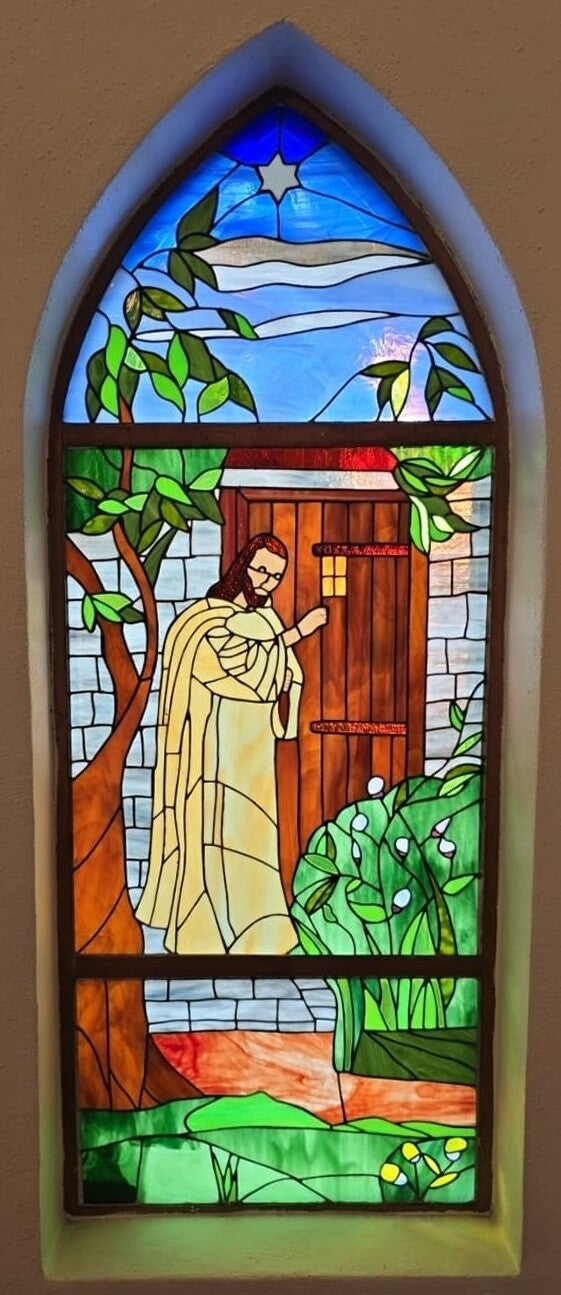
sermon series, really, from the glass. If you take a look here at the glass.
That Jesus knocking on the door, that comes from Revelation chapter 3, verse 20. It's kind of interesting. This whole
sermon series is really based on Jesus being the head of the church and why he has a right to speak to them.
Our key scripture is going to be from First Corinthians. 311and let's read it, and you're welcome
to read it together with me.
First Corinthians. 3:11
For no one can lay any foundation other than the one already laid. Which is Christ Jesus. Amen.
And good morning and welcome. Welcome.
Today we're going to begin a brand new sermon series, and this is the Seven Churches of Revelation. So the Seven Churches of Jesus is the title. And so our first sermon in this series is Jesus, the cornerstone of the church. And so I'm going to be preaching a whole sermon series, really, from the glass.. If you take a look here at the glass. That Jesus knocking on the door, that comes from Revelation chapter 3, verse 20. It's kind of interesting. This whole sermon series is really based on Jesus being the head of the church and why he has a right to speak to them.
Our key scripture is going to be from First Corinthians 3:11, and let's read it, and you're welcome to read it together with me.
First Corinthians. 3:11
For no one can lay any foundation other than the one already laid. Which is Christ Jesus. Amen
Let's bow for prayer.
Father, we thank you so much, Lord, that Jesus is our founder. Lord, no other foundation can be laid but by him and in him. Father, as we kick off this sermon series with words from our founder and thoughts by him, Father, may you bless us. Lord, as we look at this institution, Lord, the church, and for everything that your son has to say about it. Father, may you bless us not only in — but through this series as well, and may we grow and learn as a church too. It's in Jesus' name we pray. Amen.
So I've been looking forward to preaching this sermon series, and I've actually been working on it for probably 6 or 8 months. I knew that this was a sermon series that I wanted to do. And this year in particular, I think every pastor, every rabbi or teacher, every minister of the Gospel, really wants to focus on the words of the master. The words of Jesus, our founder, our leader, because they're the most important ones to teach. It's the most important part for us to get, for other people to teach about him and other people talk about him. But when he says something, that we should pay attention to. So over the next several weeks, we're going to walk through the seven churches of Revelation.
Yes, sir. Yeah, that's right.
I want to say I hope that after this sermon series that you'll be able to walk into the church and know who the founder is. Yes, sir. And that you'll be able to walk confidently in it, knowing what that firm foundation is. That is excellent, and thank you, sir.
So, over the next several weeks, we're going to walk through the seven churches of Revelation. We'll meet a church that lost its first love — wow, how tragic. We'll meet a church that endured incredible persecution, a church that tolerated false teaching, a church that appeared to be alive but was spiritually dead, a church that thought it was rich while Jesus said it was poor. These letters are deeply personal from Jesus about his church. He's the one who writes the letters. He's the one that gives the revelation. He's the author of each of those letters. He praises, he encourages, he calls his people to repent, and he promises eternal rewards for those that do.
But before, before we hear what Jesus has to say to these churches, I think we need to think about a couple of questions, and here are some important ones to think about. And here's our first one.
Why does Jesus have the right to say what he has to the churches? Anybody ever thought about that? Why would he have the right to say those things? And secondly — and there are other questions too — but why does he have the authority to examine the churches? Why does it start out with those questions in our mind, and we're going to answer those questions as we go through.
So to commend one, rebuke another, that's what Jesus does. To call one church faithful and to call another one lukewarm — so Jesus does in Revelations chapters one through three. Who gave him the authority?
Anybody ever grow up with that phrase, "Who died and made you the boss?" In Jesus' case, that holds a lot of water, doesn't it? He's our founder. Paul answers these questions with remarkable simplicity. We're going to take a look at some of that today.
So back to our key scripture.
First Corinthians. 3:11
For no one can lay any foundation other than the one already laid. Which is Christ Jesus. Amen
Everything Jesus says in Revelation flows from that truth. Jesus has authority over the Church because the Church exists because of him. That amazing — he's the founder. This all exists, in every church, in every part of the globe, exists because of him.
Today I want us to hear three reasons why Jesus is speaking to the church today, and why he's the founder.
And so here's our first point: Jesus has a right because he's the founder. Seems redundant, but it's true. And sometimes we forget that organizations are founded by somebody, aren't they? Every organization has an origin, every movement has a beginning, and every family has a founder. The church is no different. Jesus said in Matthew 16:18, "I will build my church." And notice what he didn't say. He didn't say that Peter would build his church. He didn't say that the apostles would build it, and he didn't say that pastors would build his church, did he? No, he said this: "I will build my church." The church is Christ's idea, and he's the one that launches it, from both Matthew, from the end of the Gospel when he takes off, and of course in the book of Acts, which is the history of our movement and how it begins. Pentecost was not a creation of the disciples, was it? No, it was a creation of Jesus. It was Jesus fulfilling what he had promised.
The Church belongs to Jesus because he established it. He's more than our teacher, he's our founder. Every founder has a right to define what the mission of any organization is, including the church, which Jesus created. If you've ever started a business — we have a few people that are business owners here, they founded businesses — then you understand this. You establish the mission, the values, and the purpose. And we're establishing some of those things today, right here in our church. For churches and organizations that are currently in Nigeria, we're helping them found it. You are helping them found it. They're brand new organizations in Christ.
But every founder has the right, basically, to determine what he creates. Others may help lead those things, but the one who defines it is the founder himself. Sometimes we try to redefine it, right? We try to find what it is that makes it important, but the founder is the one who sets that foundation stone, and he begins that process.
So the same is true of the church. Jesus establishes his purpose, he defines his mission, and he determines what its message is. The church doesn't exist to reflect culture, does it? How many churches do that? They want to be influencers and they want to shape culture. What the Church is supposed to do is reflect the image of Christ and his mission and message, isn't it? Wow, who am I speaking to today? Yeah, amen. The Church exists to reflect Christ.
So I want to give us kind of maybe our first application for this first piece. And so some of these reminders are important for us as we go through this. The church is not about my preference or about your preference. It isn't about what's trendy or convenient. I want to say we live in a world of trendy and convenient, don't we — selfies, self images, stuff that we see on YouTube, and there's always something brand new to click on, right? But that's not what it's about. It's not about our preference.
Every ministry, every decision, every program should begin with this question: what is it that Jesus wants for his church? Wow, he has a right to establish those things, doesn't he? What is it that Jesus wants? Before it was our church, it was his, wasn't it? Still is, isn't it? I don't want to be in a church that doesn't belong to him. Wow, doesn't sound like fellowship to me, does it? How about you? I always say that's probably the perfect definition of a cult.
Let's go into point two: Jesus has a right because he is the foundation of the church. Now Paul takes us underneath a little bit of this text: "For no one can lay any foundation other than the one already laid, which is Jesus Christ."
So every builder knows that the foundation is an important piece of the building, but you rarely see it. Anybody ever seen the footers of this church? They're there. When we were in Nigeria, we actually — we actually were there when the footers were poured for one of the buildings that we were going to do, and we laid the first five foundation stones, the keystones, and we put scripture in them. And oftentimes churches are built in that way. You know, there's scripture underneath the foundation because it's Jesus that's the foundation of the house. But it's not something that you see, because foundations aren't glamorous, are they? Now they're in the dirt, aren't they? It's what holds everything up. Nobody compliments the foundation. "Oh, that looks like a good piece of concrete work." Not unless you're a concrete guy, right? Nobody takes pictures of concrete footings, except for us, because we did — and we have pictures of some of the buildings we did in Nigeria. But everything depends on it, doesn't it, a foundation. And that can be physical and spiritual. If the foundation shifts, everything cracks. Anybody ever had drywall crack in your house because maybe your house is kind of old or something shifted, and then you got a crack in the wall? Yeah, earthquake shifts the ground. Take a look at the stuff in, you know, Italy right now, and you can see the cracks in the wall and the plaster and things like that. The foundation is cracked, and so, yeah, it's a horrible thing.
Paul says there's only one foundation that we can build on, and that is Jesus. He is the foundation of the church. Jesus Christ is the one. It's not personalities, it's not traditions, it's not programs, not denominations, no politics, but Christ alone who is the foundation of the church.
And if you look at the assembly over time, you can see that no organization outside of what God ordains could hold anything on Christ, could they? Or on God and his ability. No culture, no politics, no church, no synagogue, no temple could hold all of the things of God. He simply transcends all of those things, doesn't he? It is Christ alone.
Paul wrote these words to the Corinthian church that was deeply divided, and especially deeply divided on human leaders. So many of them said — and Paul writes about this — "I follow Paul, I follow Apollos, I follow Peter." And Paul's argument to this is simple. He says that they're arguing for the workers and forgetting about the foundation. Man, if we should be concentrating on somebody's teaching, it should be the teaching of Christ.
And I still see, I still hear and see some of that today. And I want to tell you a story about a member of our congregation, not here, many years ago in another church. They would call me after they'd heard somebody on YouTube, and then they'd ask me about it, and it was Perry Stone. Anybody follow Perry Stone? Perry Stone — I like a lot of his teaching, I like a lot of his stuff. And before my mom passed, I read books from Perry Stone to her before she passed, and it gave her comfort and gave us really something spiritually together.
But this person would call me and they would ask me, "Well, how did you feel about this message?" And before, they wouldn't tell me who it was. But after a while, after about, oh, I don't know, a month or two into it, I was like, oh, that sounds like Perry Stone. And then finally — always, like, you know, they were following Perry Stone, and that was a person that they gauged their stuff with. But then they'd call me just to make sure it was OK. I don't know that I had any real input, but, you know, or maybe they were testing me or checking me. But we have to be very careful about who we pay attention to. It's OK to follow teachers and people that we trust, you know, and I have some of those people myself, people personally, and people that I see or read about, you know, throughout Christendom. But we have to be very careful that we don't subtract what Jesus is actually saying, because he is the founder of our faith.
And I won't be seeing Perry Stone — well, maybe I'll see him in eternity, I hope I do — but I will be seeing Jesus, and you will too. It's his teaching that we're accountable to. Perry Stone, man — I doubt if you'll see us on YouTube, and he's on YouTube, but I have my own Perry Stone stories, and that's one of them.
The church was never built on gifted leaders. We have to keep that in mind, and we have a few — you know, I think of people who have led brilliantly throughout history in the church. Martin Luther, for one — brilliant leader of the church, began the Protestant Reformation from a piece of scripture that Paul wrote, the just shall live by faith. I look at Doctor Martin Luther King, who I have always been a big fan of, an advocate of, and the fact that he's a minister is impressive to me. The fact that the teachings of Jesus impressed him to talk about freedom and liberty — that was a big thing. And I think about guys like Billy Graham. You know, and everybody, I can remember when everybody had a Billy Graham story, or they went to a crusade, or they saw him on television, you know, and they heard the songs and all of those things. But the churches, they're not built on gifted leaders. It's built on one leader. It's always been built on Jesus Christ. The rest of us are followers. The rest of us are servants. We're teachers. But it is him. He is our founder, Jesus Christ.
So here's some more application. The truth reaches beyond the Church into our personal lives in many ways. But every life is being built on something, isn't it? Whether you're a believer or not a believer, you're building your life on something — some philosophy, some teaching, something like that. Some build on success, and I would say good luck with that. It's good to be successful, and we always want to hear those stories. Others build on wealth, don't they? And our President has quite a portfolio, doesn't he — built a lot of success on wealth. But a lot of people have it, a lot of people trust those things. Some build on relationships, others on achievement and reputation. But there's only one thing that you can really build on, one thing that is good and that carries weight, and that is — only Jesus can carry the weight of your soul. He's the only one. He's the founder of the church, yesterday, today, and tomorrow. It's only Jesus.
When storms come, and they will, the foundation will be revealed. And it reminds me of the parable of people building on the sand. How'd that work out? The only thing you can build on is the solid rock of Jesus Christ. He is our foundation.
Here's my last point: Jesus has the right because he is the chief cornerstone. So if you forget everything that I said in this message, remember that he is the chief cornerstone. Long before Paul wrote Corinthians, God had already revealed his Son through the prophets, and so — Psalm 118 declares the stone the builders had rejected becomes the cornerstone. Think about that for a minute. "I reject this stone, this is not fit for building." Guess what? That's the very stone that God picks. He picks the stuff we don't pick, doesn't he? He picks the people that we don't pick in dodgeball. We pick somebody that we think can throw the ball and can dodge it, right? God's not like that. And did Jesus dodge the ball? No, he took a blow, didn't he? Yeah, he sure did. He took the blow for us. He is the chief cornerstone, but he is the one that we reject.
Isaiah announces this. He says, "See, I lay a cornerstone in Zion, a tested stone, a precious cornerstone for a sure foundation." How's that foundation? Solid, it is. Sure, isn't it — tried and true.
So Peter brings these points to bear, and I'll talk about that just in a second. But I wanted to do this word study, and just mention kind of the construction of the word, this word cornerstone, or Even Pinah, which is this — this is the Hebrew of it, from Psalms 118. It isn't an ornamental stone, and I think we get that point. It wasn't something that was prettier, decorative. It wasn't placed at the end of the construction, but it was laid in the very beginning of it. That's when a cornerstone — all the weight of the building lands on it. It upholds everything. Everything is aligned to it. I want you to think about that. That's a big business word today, alignment — are you aligned? But if we're not aligned to the message of God and his building, what does that say? Wow. He is a cornerstone.
Every wall, every doorway, every measurement, every single angle is aligned to that. Every stone in its proper place is fitted together and is supported by the cornerstone. And that makes the building true. And it remains true as long as it is connected and aligned to the cornerstone. If ignored, it will drift, won't it? The wall will drift, it'll sag over time, it'll break down. You will lose alignment. Anybody ever seen a building out of alignment? Yeah. Or it's a sad thing. How about a bridge? You want to drive over it? Not something you want to trust.
So Jesus also — he is the cornerstone of our lives. And Peter, this is where he takes it a step further. In First Peter 2:5 he also says that you are living stones. Man, look at your neighbor — they don't look like stones, do they? But they are, your stones in his building. Man, yeah, you're a precious stone. You're a living stone. You're built into a spiritual house, because the building isn't a building, is it, that we know of. It's a spiritual house, and you are part of that church. I'd say, church, welcome to church, you're the church. You and all of our brothers and sisters throughout time, you are living stones built in this house. Jesus is the founder of that. He creates it. So he is a cornerstone. He doesn't merely support the church, he determines its direction, he defines its doctrine, its mission, and he measures its faithfulness too, doesn't he? Wow, what kind of builder doesn't measure stuff, right? How does that go — measure twice, cut once? At least measure twice.
I want to begin this transition now into the Book of Revelations, and I'll have more to say about it. It'll make more sense to you as we begin to go through it. But Jesus, in Revelation chapter 1, begins to walk among the lampstands, doesn't he? We'll see that as we get there, because they're there. Those churches are his churches, aren't they? That's something for us to think about. The church doesn't belong to us, the stewards of it — church belongs to him. He has every single right. And so he's walking among those churches because they're his. He praises Ephesus because he's the founder, he has a right to do that, doesn't he? Yeah, he's the founder. He comforts Smyrna — and I said it with a chapter, honey, how does it — said Smyrna, being German, I always want to put the S-C-H on everything, even Smyrna. But Jesus is a founder of that church and he comforts them, doesn't he? Jesus comforts them, and we'll see that. He rebukes Pergamum, because he's the cornerstone, he can do that, right? They're out of alignment. He warns Laodicea because he loves his church so much that he doesn't want to see it drift. Is that not a good leader? Yeah, he warns him. We'll see that warning too, because that may be our Church of our age.
He's not acting as an outsider, just giving criticism or commentary to, "Hey, how you doing, and by the way, I see this." No, he has every right, because he's the building inspector, isn't he? These are his buildings, he has every single right. Janine, if you want to start our music.
Church, before Jesus ever said, "You have forsaken your first love" — before he says that, "be faithful unto death," before he says, "repent," and before he says, "Behold, I stand and knock at the door" — before he says all of those things, he establishes his authority, doesn't he? Jesus has authority over the churches. He's the founder, he's the foundation, he's the chief cornerstone, and because of that, he alone has the right to examine and inspect his church, doesn't he? To commend his church, to correct it, to rebuke it, and yes, to judge his church too? Doesn't he give him praise and glory today in this house? Hallelujah.
Here's my final piece as we begin this series. Let's decide this together, that we're not going to read these letters and look for the shortcomings, because we all have our own, don't we? Man, we all have our own shortcomings. But let's read these letters of Jesus to the churches. Let's read them with an open heart, not asking, "Hey, what church is that?" — pointing fingers, and I want to say there's some of the church that are really good at that, and sometimes we ourselves are guilty. But we should be asking ourselves, "Lord, what are you saying to me? What are you saying to us?"
Why is this important? Because every letter ends with this same invitation: "Whoever has ears, let him hear what the Spirit says to the churches." And that invitation still stands today, doesn't it? Man, especially now.
Next week, Pastor Clint Hamilton is going to raise our hope, expectation, and our level of blessedness when he comes to speak next week. And I'm looking forward to having Pastor Clint come speak to us from Saint Louis, and I know his father would be super glad as well, maybe more than us, but we'll be blessed by his words next week.
In two weeks, we're going to join John on the rocky Isle of Patmos, and we're going to see the risen Christ walk among the lampstands, eyes like burning fire and a voice like rushing water. We're going to hear all of those things from Revelation chapter 1. And we'll discover that the one who speaks to the seven churches is not merely just a historical figure or a distant savior. And I think sometimes in church we feel like that, that we're not connected, but he's the founder.
And over the next couple of weeks, we'll hear his words: Ephesus, Smyrna, Pergamum, Thyatira, Sardis, Philadelphia, and of course the Church of Laodicea. And my prayer is this, that we won't simply gain understanding of these seven ancient churches. My prayer is that we become the kind of church that Jesus delights in and compliments and recommends. We need to know what he has to say. A church that's firmly founded on him, faithful, aligned with him, and always ready to hear his voice. May we be that church, and may we never forget what Paul declares to us.
First Corinthians. 3:11
For no one can lay any foundation other than the one already laid. Which is Christ Jesus. Amen
Let's bow forward in prayer.
Father, we thank you so much for this word, Lord, and we thank you for its power. Speak to us, Lord, through your churches, and we are your church and your people. Father, as we get ready for communion, may that be blessed as well as we welcome our brother Pete forward. Lord, we are grateful. Thank you for this word. Thank you for speaking to us, and thank you for bringing it in our language today. It's in Jesus' name we pray. Amen.
