Ephesus: Return to your First Love

The Seven Churches of Jesus
Week Two
Beyond the Sermon
A Deeper Study of the Church at Ephesus
Word studies, historical background, and further study beyond Sunday's message
1. How to Use This Guide
This guide is meant to go past what Sunday's message could cover in twenty-five minutes. Use it on your own in the days following the sermon, or as the backbone for a small-group session — there's enough here for one longer discussion or two shorter ones. Nothing here contradicts the sermon; it digs into the history, language, and larger biblical storyline standing behind it.
2. The Sermon in Brief
Jesus, seen by John on Patmos walking among seven golden lampstands, sends His first letter to Ephesus. He commends their labor, discernment, and endurance (vv. 2–3, 6) — then names what none of that outward faithfulness could hide: “You have forsaken the love you had at first” (v. 4). He calls them to remember, repent, and repeat the works of that first love (v. 5), warns that an unrepentant church can lose its lampstand, and promises the tree of life to the one who overcomes (v. 7).
Core insight: it is possible to keep every habit of devotion and lose the devotion itself. Jesus, walking among the lampstands, sees the difference between serving Him and loving Him.
3. Word Studies
Sunday's message covered lychnia, angelos, and prōtē agapē. Here is the fuller set of terms that shape this letter.
| Term | Original | Meaning & Significance |
|---|---|---|
| Lampstand | λυχνια (lychnia) | The tabernacle menorah of Exodus 25:31–40 — hand-hammered gold, fed continually with oil, never allowed to go dark. Jesus identifies the lampstands directly as “the seven churches” (Rev. 1:20). |
| Messenger | áγγελος (angelos) | “Messenger” — used of both heavenly beings and human envoys elsewhere in the NT (Luke 7:24; James 2:25). Held in Christ's right hand (1:16, 20), under His authority. |
| Hard work | κóπος (kopos) | Labor to the point of weariness or exhaustion — not casual effort but costly toil, the same word Paul uses of his own ministry (1 Cor. 15:10). |
| Perseverance | υπομονé (hypomonē) | Literally “remaining under” — the capacity to stay in place and hold ground under sustained pressure, rather than the passive sense of “waiting it out.” |
| First love | πρωτη αγáπη (prōtē agapē) | The wholehearted, ardent devotion of the church's beginning — the same love Paul prayed this congregation would grasp in its “width and length and height and depth” (Eph. 3:17–18). |
| Repent | μετανοέω (metanoeō) | A change of mind (meta + nous) that produces a change of direction — not mere regret, but a decisive turn, used five times across the seven letters. |
| Nicolaitans | ΝικολαΙτης (Nikolaïtēs) | A group named for its practices only here and in 2:15 (Pergamum); see Section 6 below for the historical background and interpretive options. |
| Paradise | παρáδεισος (paradeisos) | A Persian loanword for a walled royal garden, used in the Greek Old Testament for Eden (Gen. 2:8) and by Jesus of the believer's destiny (Luke 23:43). |
4. Ephesus: The City Behind the Letter
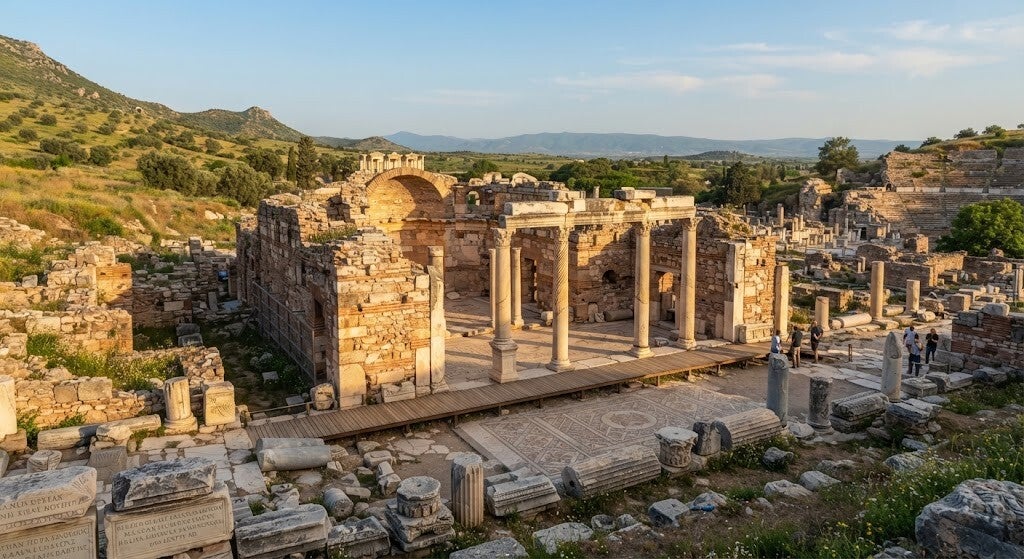
Understanding Ephesus itself sharpens why Jesus's words landed the way they did. In the first century, Ephesus was one of the four or five most important cities in the Roman world — a bustling harbor at the mouth of the Cayster River, the administrative capital of the province of Asia, and a banking center where temples doubled as treasuries.
Dominating the skyline was the Temple of Artemis (Diana to the Romans), one of the seven wonders of the ancient world — a structure roughly four times the footprint of the Parthenon, ringed with over a hundred columns, and served by a guild of priestesses and craftsmen whose livelihood depended on Artemis worship. The city's identity, economy, and civic pride were bound up with that temple.
Into this setting Paul arrived around AD 52–53 and spent the better part of three years teaching daily, “so that all the Jews and Greeks who lived in the province of Asia heard the word of the Lord” (Acts 19:10). The gospel's advance was disruptive enough that silversmiths who made shrines of Artemis incited a riot, fearing the loss of “our trade” and the temple's reputation (Acts 19:23–41) — a reminder of just how countercultural it was for Ephesian believers to hold the line Jesus commends in Revelation 2:2, 6.
By the time Paul said his tearful farewell to the Ephesian elders at Miletus — “I know that after I leave, savage wolves will come in among you” (Acts 20:29) — this congregation was already one of the most mature, most taught, and most theologically equipped in the empire. That is precisely what makes Revelation 2:4 so sobering: this was not a young, untaught church losing its way. It was a seasoned one.
A Timeline: Paul to Patmos
| Date (approx.) | Event |
|---|---|
| c. AD 52–55 | Paul plants and pastors the church at Ephesus for nearly three years (Acts 19) |
| c. AD 55 | Riot of the silversmiths — Ephesian devotion to Artemis collides with the gospel's advance (Acts 19:23–41) |
| c. AD 57 | Paul's farewell to the Ephesian elders at Miletus; warns of “savage wolves” to come (Acts 20:17–38) |
| c. AD 60–62 | Paul writes the letter of Ephesians, likely from Roman imprisonment — a letter saturated with the language of love (Eph. 1:4–5, 3:17–19) |
| c. AD 62–64 | Timothy serves as Paul's delegate to the Ephesian church (1 Timothy 1:3) |
| Late 1st century | Church tradition holds the apostle John later leads the Ephesian church |
| c. AD 95 | John, exiled on Patmos, writes Revelation; the risen Christ addresses Ephesus first among the seven churches (Rev. 2:1–7) |
5. “First Love”: Ephesians Then, Revelation Now
Placing Paul's letter to this church beside Christ's letter to this church, roughly thirty-five years apart, makes the diagnosis of Revelation 2:4 land with full weight.
| Ephesians (c. AD 60–62) | Revelation 2 (c. AD 95) |
|---|---|
| “For this reason… I do not cease to give thanks for you” (1:15–16) | “I know your deeds, your hard work and your perseverance” (2:2) — labor remains, but is named apart from love |
| “That you, being rooted and established in love, may have power… to grasp how wide and long and high and deep is the love of Christ” (3:17–18) | “Yet I hold this against you: you have forsaken the love you had at first” (2:4) |
| “The eyes of your heart may be enlightened, in order that you may know the hope to which he has called you” (1:18) | “Consider how far you have fallen” (2:5) — a call to see clearly what had gone dim |
| A congregation described in the language of wonder and affection | A congregation described in the language of correct, weary duty |
6. Who Were the Nicolaitans?
Jesus commends Ephesus for hating “the practices of the Nicolaitans” (2:6), and the same group reappears at Pergamum (2:14–15), linked there to “the teaching of Balaam” — eating food sacrificed to idols and sexual immorality. Scripture never fully defines the group beyond these two mentions, so several explanations have circulated since the early church.
Some early church writers (Irenaeus, Hippolytus) associated the name with Nicolas, one of the seven men chosen to serve in Acts 6:5 — though the New Testament itself says nothing to connect that Nicolas to false teaching, and most modern scholars treat this as a later, unverifiable tradition rather than a settled fact. A second view treats “Nicolaitans” less as a fixed sect and more as a description: the Greek name (nikaō, “to conquer,” + laos, “people”) may function as a Greek equivalent of “Balaamite,” describing a party that counseled compromise with pagan culture — participating in trade-guild feasts tied to idol worship, and the sexual license that often accompanied them — for the sake of social and economic comfort in a city like Ephesus.
Whichever the case, the practical shape of the error is clear from context: it offered believers a way to blend in with Ephesus's civic and commercial life rather than stand apart from it. That Ephesus refused this compromise (2:6) while still losing its first love (2:4) is itself instructive — right doctrine and right practice on this front did not, by themselves, keep their devotion warm.
7. The Tree of Life: From Eden to New Jerusalem
The letter's closing promise — “the right to eat from the tree of life, which is in the paradise of God” (2:7) — is not a stray image. It is the final letter's echo of the Bible's first chapters, and Revelation will complete the circle in its last.
| Eden (Genesis 2–3) | New Jerusalem (Revelation 22) |
|---|---|
| The tree of life stands in the garden, freely available (Gen. 2:9) | The tree of life stands beside the river of life in the New Jerusalem (Rev. 22:2) |
| After sin, humanity is barred from the tree and driven from the garden (Gen. 3:22–24) | “Blessed are those who… may have the right to the tree of life” (Rev. 22:14) |
| Cherubim and a flaming sword guard the way back (Gen. 3:24) | “Nothing accursed will be found there anymore” (Rev. 22:3) — the barrier is gone |
| Access lost through the first Adam's fall | Access restored to “the one who is victorious” (Rev. 2:7) through Christ, the last Adam |
Set beside Revelation 2, the promise reframes the whole letter: Jesus is not merely scolding a cooling church. He is holding out, to the very congregation that had drifted from Him, a share in the ending He is writing for the whole story — the paradise that was lost in a garden, fully regained in a city.
8. Reflection Questions
- Ephesus was one of the most mature, best-taught churches in the empire — and still lost its first love. What does that suggest about the relationship between theological maturity and spiritual warmth?
- Read Ephesians 3:14–19 alongside Revelation 2:4. If someone wrote a letter describing your devotion to Christ today, would it read more like the first passage or the second? What would need to change?
- The Nicolaitans (whatever their exact identity) represented a path of compromise that let believers blend comfortably into Ephesian civic life. What are the modern equivalents of that kind of comfortable compromise — pressures to blend in rather than stand apart?
- The tree of life connects Eden's loss to the New Jerusalem's restoration. How does knowing the end of the story — full restoration — change how you respond to Jesus's correction in the middle of it?
- What is one “first work” from earlier in your walk with Christ — a practice, a rhythm, a posture — that this study is prompting you to return to?
9. Further Study
For continued personal study this week, these passages extend the themes above:
| Passage | Connects To |
|---|---|
| Acts 19:1–41 | The founding of the Ephesian church and the riot of the silversmiths — the world Ephesus had to resist |
| Acts 20:17–38 | Paul's farewell charge to the Ephesian elders, including his warning about “savage wolves” |
| Ephesians 1:15–23; 3:14–21 | Paul's original prayer for this congregation's love — the standard against which Rev. 2:4 is measured |
| 1 Timothy 1:3–7 | Timothy's charge at Ephesus to guard sound doctrine — commendable, but note the same risk of correctness without love (1 Tim. 1:5) |
| Deuteronomy 6:4–9 | The Shema — Israel's own call to wholehearted love for God, the Old Testament root of “first love” |
| Genesis 2:8–9; 3:22–24 | The tree of life in Eden — background for the promise of Revelation 2:7 |
| Revelation 22:1–5, 14 | The tree of life restored — where the promise to Ephesus is finally fulfilled |