

4. Pergamum: The Church of Compromise

THE SEVEN CHURCHES OF JESUS
Beyond the Sermon
Pergamum:
The Church of Compromise
Covington Community Church
A deeper study for personal or small-group use following the sermon
How to Use This Guide
This “Beyond the Sermon” guide is meant to take you deeper into the letter to Pergamum than a single message can go. It includes historical background on the city itself, word studies on the key terms Jesus used, comparison and timeline material to help you see where this letter fits in the larger story of Revelation 1–3, and reflection questions for personal journaling or group discussion.
You do not need to complete it all in one sitting. Read a section, sit with it, and let the Spirit apply it where it needs to land.
The Text
Revelation 2:12–17 (NIV)
|
“To the angel of the church in Pergamum write: These are the words of him who has the sharp, double-edged sword. I know where you live—where Satan has his throne. Yet you remain true to my name. You did not renounce your faith in me, not even in the days of Antipas, my faithful witness, who was put to death in your city—where Satan lives. Nevertheless, I have a few things against you: There are some among you who hold to the teaching of Balaam, who taught Balak to entice the Israelites to sin so that they ate food sacrificed to idols and committed sexual immorality. Likewise, you also have those who hold to the teaching of the Nicolaitans. Repent therefore! Otherwise, I will soon come to you and will fight against them with the sword of my mouth. Whoever has ears, let them hear what the Spirit says to the churches. To the one who is victorious, I will give some of the hidden manna. I will also give that person a white stone with a new name written on it, known only to the one who receives it.” |
The Setting: Pergamum in History
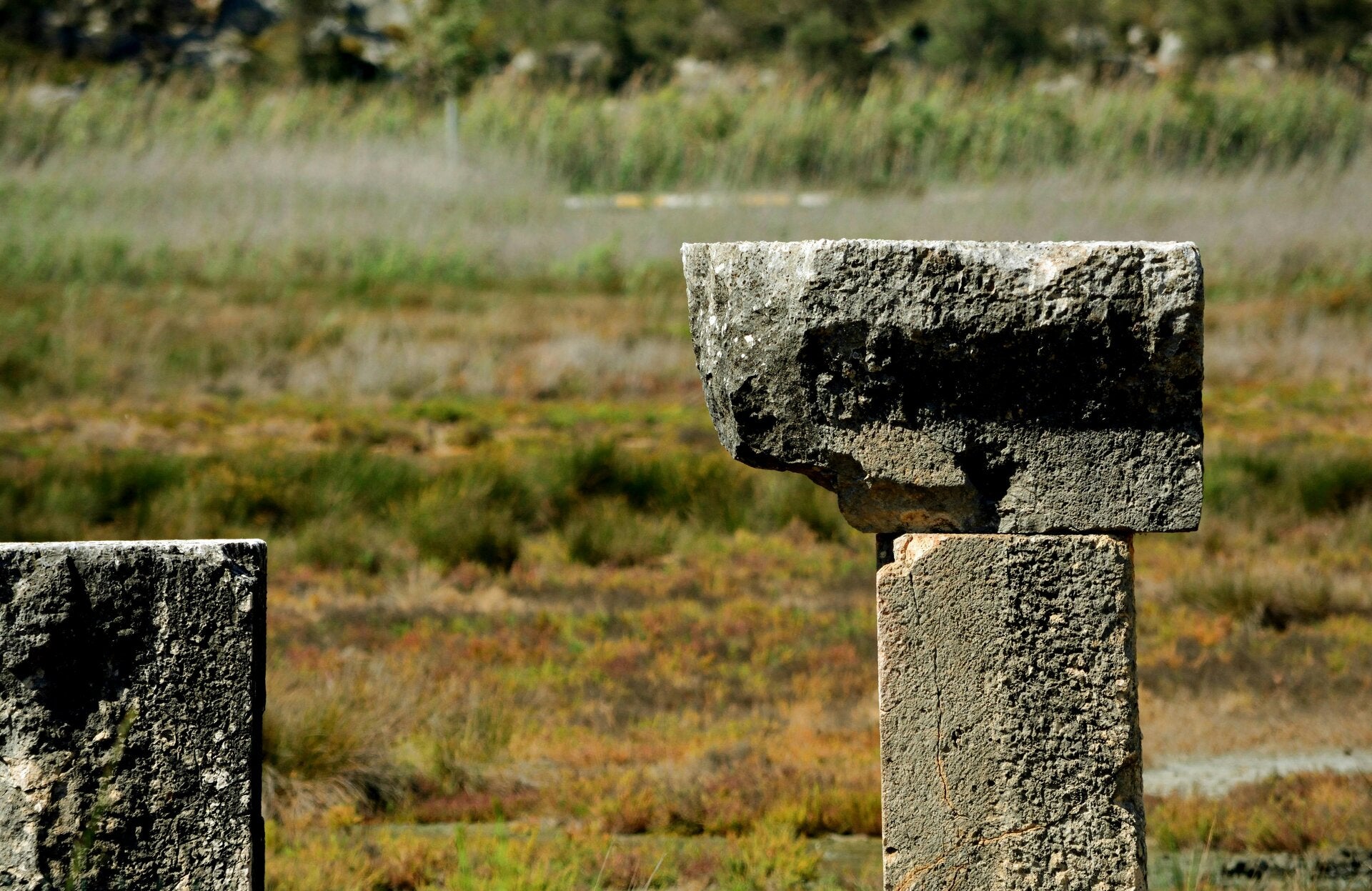
Pergamum sat roughly fifteen miles inland from the Aegean coast in the ancient region of Mysia (modern Bergama, Turkey). Long before Ephesus rose to prominence, Pergamum had served for generations as the leading city and cultural capital of the province of Asia — a city of libraries, temples, and imperial favor.
Its library reportedly held over 200,000 scrolls, rivaling the great library of Alexandria. According to tradition, when Egypt restricted papyrus exports to slow Pergamum's collection, the city's scholars perfected a new writing material from treated animal skins — our word “parchment” comes from the Latin pergamena, “the Pergamum material.”
The city was built on and around a dramatic acropolis rising over 1,000 feet above the plain — one of the most fortified and visually commanding cities in Asia Minor.
The city was saturated with pagan worship: temples to Zeus, Athena, and Dionysus stood alongside a famous healing sanctuary devoted to Asclepius, the god of medicine, whose symbol was a serpent coiled around a staff. Sick pilgrims traveled from across the empire seeking a cure there.
In 29 BC, Pergamum became the first city in Asia to be granted permission to build a temple to a living Roman emperor (Augustus). It quickly became a center of the imperial cult, where refusing to burn incense to Caesar as “lord” could cost a person their life.
“Where Satan Has His Throne”
Jesus's description of Pergamum as the place “where Satan has his throne” is unique among the seven letters — no other city receives so direct a spiritual diagnosis. Bible scholars have offered several explanations, and they are not mutually exclusive:
- The Great Altar of Zeus — an enormous horseshoe-shaped altar built on a terrace of the acropolis, visible for miles and famous throughout the ancient world (portions of it are now displayed in Berlin's Pergamon Museum).
- The imperial cult — Pergamum's early and zealous role as a center of emperor worship, where political and religious loyalty to Rome were fused together.
- The cult of Asclepius — the serpent-entwined healing god, whose imagery (and, some suggest, live serpents kept in the temple precincts) carried an unmistakable resonance with the “ancient serpent” of Revelation 12:9.
Whatever the precise referent, Jesus's point stands: He was fully aware of the spiritual density of the environment His people lived in — and He commended them for standing firm inside it.
|
Word Study • Pergamum (Gr. Pérgamos) The name's root is debated, but it is closely related to words for “citadel” or “height” — fitting for a city whose acropolis dominated the surrounding plain. The same root gives us pergamene, the treated animal-skin writing material developed there — the origin of the English word “parchment.” |
Antipas: My Faithful Witness
Jesus singles out one believer by name — Antipas — calling him “my faithful witness.”
Early church tradition (recorded later by writers such as Tertullian) remembers Antipas as a bishop of Pergamum martyred under Emperor Domitian, reportedly by being roasted alive inside a bronze bull-shaped altar to a pagan god. Scripture itself gives no details beyond his faithfulness unto death, but the tradition underlines how real and costly the pressure in Pergamum was.
The Greek word for “witness” here is martys — the very word from which we get “martyr.” In the earliest church, bearing witness to Christ and being willing to die for that witness were not yet separate ideas.
Deep Dive: The Doctrine of Balaam
To explain the compromise inside Pergamum, Jesus reaches back to one of the strangest and most instructive stories in the Old Testament — the account of Balaam in Numbers 22–25 and 31.
Balak, king of Moab, hired the prophet Balaam to curse Israel as the nation approached the Promised Land. Three times Balaam opened his mouth to curse Israel, and three times God turned the curse into a blessing (Numbers 23–24) — including the famous prophecy of a “star out of Jacob” (Numbers 24:17). Balaam discovered that Israel could not be cursed from the outside because God had already blessed them. So the strategy changed.
Numbers 31:16 later reveals that it was Balaam who advised the Moabites to send their women into the Israelite camp, drawing the men into idol feasts and sexual immorality (recorded in Numbers 25) — 24,000 Israelites died in the plague that followed.
The New Testament treats “the way of Balaam” as a recognizable pattern of false teaching that trades holiness for compromise in exchange for personal gain or acceptance (2 Peter 2:15–16; Jude 1:11). Some in Pergamum had apparently adopted a version of this same reasoning — perhaps arguing that eating food offered to idols at trade-guild banquets, or participating loosely in the sexual norms of the culture, was a harmless accommodation to life in a pagan city.
|
Word Study • Balaam (Heb. Bil‘am) The etymology is disputed. Two common proposals are “devourer / glutton (of the people)” and “not of the people,” both plausibly reflecting the negative light in which Scripture ultimately portrays him. Balaam is a genuinely unusual figure: a pagan diviner who nonetheless spoke authentic, Spirit-given prophecy over Israel — and yet who is remembered in both Testaments as a byword for a prophet who loved “the wages of wickedness” (2 Peter 2:15). |
The Nicolaitans
Jesus also names “the teaching of the Nicolaitans” — a group already condemned by their actions in the letter to Ephesus (Revelation 2:6), where the church was commended for hating what they did. In Pergamum, by contrast, the church had apparently begun to tolerate them.
|
Word Study • Nicolaitans (Gr. Nikolaïtai) The name likely derives from Nikolaos — built from nikao (“to conquer”) and laos (“people”) — “conqueror/victor of the people.” Some interpreters note the possible wordplay with “Balaam,” since both names can be read to carry a similar sense in Hebrew and Greek, suggesting the two groups represent the same essential error under two names. A later church tradition (Irenaeus, c. AD 180) connected the group to Nicolas of Antioch, one of the seven men chosen to serve in Acts 6:5, though Scripture nowhere confirms this link, and many scholars regard it as speculative. |
Whatever their origin, their teaching is consistently associated with tolerating idol-food and sexual immorality — practically identical to “the way of Balaam” applied within a Gentile congregation.
Tolerance, Not Unanimous Belief
It is worth noting precisely what Jesus says: “you also have those who hold to the teaching of the Nicolaitans” — not that the whole church embraced this teaching. The issue Jesus confronts is that the church had decided to allow it. Grace welcomes broken and struggling people without exception; it does not, however, require a church to rename what Scripture calls sin. John describes Jesus Himself as “full of grace and truth” (John 1:14) — both together, neither one sacrificed for the other.
|
Word Study • Repent (Gr. metanoéō) Built from meta (change) + noeō (to perceive, to think) — literally “to change one's mind” in a way that reorients the whole direction of life, not mere regret over consequences. This is a different word from metamelomai, used of Judas's remorse in Matthew 27:3 — sorrow without a change of direction. The repentance Jesus calls for in Pergamum is a decisive turning, not a passing feeling. |
Two Strategies of the Enemy
Placed side by side, Smyrna and Pergamum illustrate two very different pressures the church faces — and Pergamum's warning is that surviving one does not guarantee surviving the other.
|
|
Pressure from Outside |
Compromise from Inside |
|
Old Testament pattern |
||
|
Goal of the enemy |
Destroy the church through force |
Dilute the church through accommodation |
|
How it feels |
Obvious, painful, easy to resist together |
Subtle, comfortable, easy to excuse alone |
|
Pergamum's response |
Held fast — even Antipas's death did not move them |
Tolerated it — “it's not that serious” |
|
Modern parallel |
Ridicule, exclusion, or cost for public faith |
Quiet compromises in speech, entertainment, relationships, ethics |
Where This Letter Fits: The Seven Churches So Far
Each letter in Revelation 2–3 builds on the ones before it. Seeing them together helps clarify what Jesus is doing across the whole series.
|
Church |
Central Issue |
Jesus's Call |
|
Sound doctrine, but a love for Christ grown cold |
“Remember, repent, and do the things you did at first.” |
|
|
Poverty and persecution from outside |
“Do not be afraid… be faithful, even to the point of death.” |
|
|
Doctrinal compromise tolerated from inside |
“Repent therefore… hold fast to my name.” |
The Promise to the Overcomer
Hidden Manna
The promise recalls Exodus 16, where God fed Israel with bread from heaven in the wilderness. Numbers 17 and Hebrews 9:4 speak of a jar of manna preserved inside the Ark of the Covenant as a lasting memorial of God's provision — manna “hidden” from ordinary use, kept in the place of His presence.
Jesus had already told a crowd in Capernaum, “I am the bread of life… whoever comes to me will never go hungry” (John 6:35, 48). To a church tempted to find satisfaction in idol feasts and cultural belonging, Jesus offers something the world's tables cannot supply: Himself, sufficient and hidden away for those who remain faithful.
The White Stone
|
Word Study • White Stone (Gr. psēphos leukē) Psephos referred to any small, smooth stone used for counting, voting, or casting a verdict. Several ancient customs have been proposed as background for this image, and they are not mutually exclusive:
|
For Reflection
Take time with each question. Some may be answered quickly; others may take a week of honest prayer.
- Where in your life right now are you experiencing pressure to soften, hide, or stay silent about your faith? What would “hold fast” look like there this week?
- Pergamum's compromise did not begin with a dramatic decision — it began with small phrases like “it's not that serious” or “everyone does it.” Can you name a place where you have used similar reasoning?
- Jesus distinguishes between loving people and approving everything they believe or do. Is there a relationship or situation where you have confused the two?
- Read John 1:14 and 1:17. What might it look like this week to hold grace and truth together rather than choosing one over the other?
- Where has Scripture recently “cut through” a rationalization you were making for yourself (Hebrews 4:12)?
- What would genuine repentance — a change of direction, not just a feeling — look like for you today?
For Further Study
If you want to keep digging into this letter on your own, these passages fill out the background referenced above:
- Numbers 22–25 — the full account of Balak, Balaam, and Israel at Baal Peor
- Numbers 31:15–16 — Balaam's counsel identified as the cause of Israel's sin
- 2 Peter 2:12–19 and Jude 1:3–13 — the New Testament's warning against “the way of Balaam”
- John 1:14–17 and John 6:25–51 — Jesus as full of grace and truth, and as the true bread from heaven
- Exodus 16:31–35 and Hebrews 9:1–4 — the hidden manna kept before the Lord
- Hebrews 4:12–13 — the living and active Word as a double-edged sword
- Revelation 1:12–20 — Christ's original self-description to all seven churches
Covington Community Church • The Seven Churches of Jesus
click the map to bring it to life

