

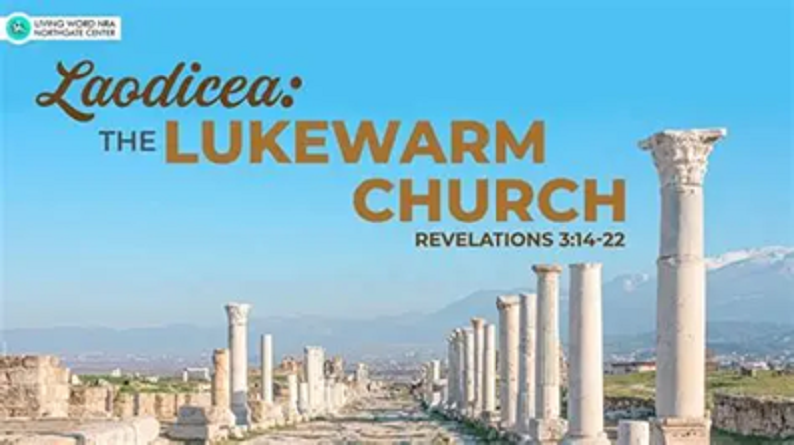
the 7 churches of Revelation : Laodicea

the 7 churches of Revelation :
Laodicea: Temperature Matters, Part One
|
BEYOND THE SERMON The Seven Churches of Jesus • Week Eight Laodicea: Temperature Matters Part One • Revelation 3:14–18 |
This guide is designed to take you deeper than Sunday morning allowed. Work through it on your own, with a spouse, or with a small group. Read the passage slowly, dig into the background and word studies, and then let the reflection questions take your own spiritual temperature. Scripture quotations are from the NIV unless otherwise noted.
THE TEXT
|
¹⁴ “To the angel of the church in Laodicea write: These are the words of the Amen, the faithful and true witness, the ruler of God’s creation. ¹⁵ I know your deeds, that you are neither cold nor hot. I wish you were either one or the other! ¹⁶ So, because you are lukewarm—neither hot nor cold—I am about to spit you out of my mouth. ¹⁷ You say, ‘I am rich; I have acquired wealth and do not need a thing.’ But you do not realize that you are wretched, pitiful, poor, blind and naked. ¹⁸ I counsel you to buy from me gold refined in the fire, so you can become rich; and white clothes to wear, so you can cover your shameful nakedness; and salve to put on your eyes, so you can see.” — Revelation 3:14–18 (NIV) |
THE BIG IDEA
The most dangerous spiritual condition is the one we can no longer see. Laodicea’s problem was not weakness or struggle — it was self-sufficiency. They had so much that they believed they needed nothing. Lukewarm faith is faith that has lost its dependence, and the cure is not trying harder to look religious. The cure is returning to Jesus: “Buy from me.”
|
Point One |
Point Two |
Point Three |
|
Jesus knows the true condition of His Church (v. 14–15) |
Lukewarm faith is a faith that has lost its dependence (v. 15–17) |
Jesus exposes what they cannot see — and offers the cure (v. 17–18) |
HISTORICAL BACKGROUND
Laodicea at a Glance
|
Feature |
Details |
|
Founded |
Established in the mid-200s BC by the Seleucid king Antiochus II, who named it after his wife, Laodice. |
|
Location |
The Lycus River valley in Phrygia (modern-day Turkey), on a major east–west trade road. Hierapolis sat about six miles to the north; Colossae about ten miles to the east. |
|
Banking |
One of the wealthiest cities in Asia Minor. The Roman statesman Cicero wrote of cashing his letters of credit there — it was a regional financial hub. |
|
Textiles |
Famous for a glossy black wool from locally bred sheep, woven into expensive garments sold across the empire. |
|
Medicine |
Home to a well-known medical school associated with the nearby temple of Men Karou. It was linked to a “Phrygian powder” used to make eye salve (collyrium). |
|
Independence |
When an earthquake devastated the city around AD 60, the Roman historian Tacitus records that Laodicea rebuilt from its own resources without asking Rome for help. |
|
Weakness |
No reliable water source of its own. Water was piped in by aqueduct from springs several miles away. |
|
Christian roots |
The church likely began through the ministry of Epaphras (Col. 1:7; 4:12–13). Paul labored in prayer for them (Col. 2:1) and wrote them a letter that has not survived (Col. 4:16). |
The Water Problem
Jesus’ words about temperature would have landed immediately in Laodicea, because the whole valley knew the three cities by their water:
|
City |
Its Water |
What It Was Good For |
|
Hierapolis |
Hot mineral springs |
Bathing, comfort, healing. Its white travertine terraces (modern Pamukkale) are still visible across the valley from Laodicea’s ruins. |
|
Colossae |
Cold, fresh mountain water |
Drinking and refreshment — the kind of water that revives a tired traveler. |
|
Laodicea |
Lukewarm, mineral-heavy water |
Arrived by aqueduct tepid and loaded with calcium deposits (still visible in the city’s stone pipes). Unpleasant enough to make a person spit it out. |
|
A common misreading. Many assume “cold” means hostile to Christ and “hot” means on fire for Him — which would make Jesus prefer open rejection to half-hearted faith. The local geography points another direction. Both hot water and cold water were useful. Lukewarm water was useful for neither. Jesus is not saying “I’d rather you hate Me”; He is saying “your faith has become ineffective — it neither heals nor refreshes.” |
Proud of Its Independence
Laodicea’s rebuilding after the earthquake became a point of civic pride: they did it themselves. That spirit is exactly what Jesus quotes back to the church in verse 17 — “I am rich; I have acquired wealth and do not need a thing.” The culture of the city had quietly become the culture of the congregation. The attitude that made Laodicea successful in business was making it bankrupt before God.
WORD STUDIES
|
אָמֵן / ἀμήν amēn — “truly, so be it, firm” Jesus introduces Himself as “the Amen” — the only place in Scripture where it is used as a personal title. The Hebrew root means firm, reliable, certain. Isaiah 65:16 twice calls the LORD “the God of truth” — literally, “the God of Amen.” Why it matters: Laodicea had its own assessment of itself. Jesus is the final, reliable word. His evaluation settles the matter (see also 2 Cor. 1:20). |
|
ἀρχή archē — “ruler, beginning, source” The NIV renders it “the ruler of God’s creation.” The word carries the idea of origin and first place — not that Jesus was the first thing created, but that He is the Source and Sovereign over all creation. Paul made the same point in the letter the Laodiceans would have heard read aloud: “by him all things were created” (Col. 1:15–18; cf. Col. 4:16). Why it matters: The One who made all things is the One who says, “You need Me.” |
|
χλιαρός chliaros — “lukewarm, tepid” This word appears only here in the entire New Testament. Jesus sets it between two contrasting words: ζεστός (zestos), “boiling hot,” and ψυχρός (psychros), “cold.” Zestos is related to the verb Paul uses in Romans 12:11 — “keep your spiritual fervor” (literally, be “boiling” in spirit). Psychros is the word Jesus used for “a cup of cold water” given to a disciple (Matt. 10:42). Why it matters: Both hot and cold describe something that serves a purpose. Lukewarm describes something that has lost it. |
|
ἐμέω emeō — “to vomit, to spew out” The NIV’s “spit you out” is actually the gentler rendering; the word describes a physical, involuntary rejection. Notice also the phrase “I am about to” — the verb (mellō) signals something impending, not yet done. There is still time to respond. Why it matters: Jesus’ warning is severe, but it is a warning — and a warning is a mercy. |
|
ταλαίπωρος … ἐλεεινός … πτωχός talaipōros … eleeinos … ptōchos — “wretched … pitiful … poor” Talaipōros (“wretched”) is the word Paul uses of himself in Romans 7:24: “What a wretched man I am!” Eleeinos (“pitiful”) appears elsewhere only in 1 Corinthians 15:19 — “we are of all people most to be pitied.” Ptōchos is not the word for someone who is merely “low on funds”; it describes the destitute beggar — the same word Jesus used in “Blessed are the poor in spirit” (Matt. 5:3). Why it matters: The very thing Jesus blesses in Matthew 5:3 — knowing you are spiritually bankrupt — is the thing Laodicea could not see. |
|
κολλούριον kollourion — “eye salve” A medicinal paste pressed into small rolls or cakes, then dissolved and applied to the eyes. Our English word “collyrium” comes from it. For a city famous for its eye medicine, the image would have been unmistakable. Why it matters: Laodicea could treat everyone’s eyes but its own. Only Jesus can give spiritual sight (John 9:39–41). |
BOAST, DIAGNOSIS, REMEDY
Jesus takes each of Laodicea’s three points of pride and turns it into a picture of what they were missing:
|
City Known For |
What Jesus Saw |
What Jesus Offered |
Scripture Connections |
|
Banking & wealth |
“Poor” |
Gold refined in the fire |
Faith tested by fire is worth more than gold (1 Pet. 1:7); treasure in heaven (Matt. 6:19–21) |
|
Luxurious black wool |
“Naked” |
White clothes |
Clothed in garments of salvation (Isa. 61:10); white garments in Sardis (Rev. 3:4–5); fine linen of the saints (Rev. 19:8) |
|
Eye-salve medicine |
“Blind” |
Salve for your eyes |
“Open my eyes that I may see” (Ps. 119:18); the blind who claim to see (John 9:39–41) |
Notice the word “buy” (v. 18). The Laodiceans were buyers and sellers by trade — but what Jesus offers cannot be purchased with their currency. Isaiah 55:1 captures the paradox: “Come, buy and eat! Come, buy wine and milk without money and without cost.” The price is not money. The price is admitting you need it.
“I KNOW” — SEVEN LETTERS COMPARED
In every letter, Jesus begins with what He knows. Laodicea stands out as the only church that receives no word of commendation at all.
|
Church |
“I know…” (NIV) |
Commendation |
Correction |
|
Ephesus |
“your deeds, your hard work and your perseverance” (2:2) |
Yes |
Yes |
|
Smyrna |
“your afflictions and your poverty — yet you are rich!” (2:9) |
Yes |
None |
|
Pergamum |
“where you live — where Satan has his throne” (2:13) |
Yes |
Yes |
|
Thyatira |
“your deeds, your love and faith, your service and perseverance” (2:19) |
Yes |
Yes |
|
Sardis |
“you have a reputation of being alive, but you are dead” (3:1) |
A faithful few (3:4) |
Yes |
|
Philadelphia |
“See, I have placed before you an open door” (3:8) |
Yes |
None |
|
Laodicea |
“that you are neither cold nor hot” (3:15) |
None |
Yes |
Mirror Images: Smyrna and Laodicea
|
|
Smyrna (Rev. 2:8–11) |
Laodicea (Rev. 3:14–18) |
|
Outward condition |
Poor, persecuted, afflicted |
Wealthy, comfortable, secure |
|
Jesus’ verdict |
“Yet you are rich!” |
“You are … poor” |
|
The lesson |
Earthly poverty cannot cancel spiritual riches |
Earthly riches cannot hide spiritual poverty |
Appearance vs. Reality: Sardis and Laodicea
Both churches were misreading themselves. Sardis had a reputation for being alive, but Jesus said it was dead (3:1). Laodicea had a reputation for prosperity, but Jesus said it was poor (3:17). In both cases, what people could see was not what Jesus saw. As 1 Samuel 16:7 reminds us, “People look at the outward appearance, but the LORD looks at the heart.”
ONE DEGREE AT A TIME
Nobody decides to become lukewarm. It happens gradually, like a cup of coffee left on the counter. Use the chart below as an honest self-check — not to condemn yourself, but to notice where the heat may be leaving.
|
Warning Sign |
What It Can Sound Like |
A Step Back Toward Dependence |
|
Prayer becomes optional |
“I’ll pray when I have time.” |
Set one fixed moment each day to tell God plainly, “I need You” (Ps. 5:3). |
|
Scripture becomes familiar |
“I already know that one.” |
Read a familiar passage slowly and ask, “What is this saying to me today?” (Ps. 119:18). |
|
Worship becomes routine |
“I went through the motions.” |
Come to worship having already prayed for your own heart (John 4:23–24). |
|
Conviction becomes quieter |
“It’s not that big a deal.” |
Invite God to search you — and respond when He does (Ps. 139:23–24). |
|
Comfort outranks calling |
“That would be too disruptive.” |
Ask where Jesus may be calling you to trust Him beyond your resources (Luke 9:23). |
|
Struggling is not the same as lukewarm. Every believer gets tired. Every Christian has seasons when prayer is harder and faith is stretched. Jesus does not condemn weakness — in fact, weakness that turns to Him is the opposite of lukewarm (2 Cor. 12:9–10). The Laodicean problem was not “I’m struggling.” It was “I don’t need a thing.” |
A PROPHETIC PERSPECTIVE
The primary meaning of each letter is historical: these were real congregations in real cities in the first century, and every letter speaks to believers in every age (“what the Spirit says to the churches”). Many premillennial, dispensational interpreters have also observed that the order of the seven letters seems to trace the broad course of the Church Age, with Laodicea — the final church — picturing the condition of much of the professing church in the last days before Christ returns for His own.
That reading fits other New Testament warnings about the end of the age: people who are “lovers of themselves, lovers of money … having a form of godliness but denying its power” (2 Tim. 3:1–5), and Jesus’ own question, “When the Son of Man comes, will he find faith on the earth?” (Luke 18:8). Whether or not one holds that view, the application is the same and it is urgent: comfort and prosperity are not proof of spiritual health.
REFLECTION QUESTIONS
Point One — Jesus Knows the True Condition of His Church
1. Why do you think Jesus introduces Himself as “the Amen, the faithful and true witness” before He says anything else to Laodicea? How does knowing His evaluation is always accurate make you feel?
2. We tend to measure churches by attendance, buildings, programs, and reputation. What measurements do you think Jesus uses? How might our church look different if we measured ourselves by His standards?
3. Set aside your attendance, your title, and how long you’ve been a Christian. What do you think Jesus sees when He looks at your spiritual life today?
Point Two — Lukewarm Faith Has Lost Its Dependence
4. How does understanding the hot springs of Hierapolis and the cold water of Colossae change the way you read verses 15–16?
5. The sermon said, “Lukewarm faith says: ‘I want Jesus, but I do not want to depend on Him.’” Where in your life are you most tempted to say, “I’ve got this on my own”?
6. Look at the “One Degree at a Time” chart. Which warning sign do you recognize most in your own life right now? What is one step back toward dependence you could take this week?
7. Why might comfort on the inside be a greater threat to a church than opposition from the outside? Have you seen this in your own walk with God?
Point Three — Jesus Exposes What They Cannot See
8. “You do not realize…” How is it possible to be spiritually blind and not know it? Who in your life has permission to tell you the truth about your spiritual condition?
9. Jesus turned Laodicea’s strengths (banking, wool, eye medicine) into pictures of their need. What are the “strengths” in your life that could quietly become substitutes for depending on Him?
10. Jesus says, “Buy from me.” Why is it significant that the solution is found in Jesus Himself and not in greater religious effort?
Check the Temperature
11. On a scale from cold to hot, where would you honestly place your spiritual temperature today — not ten years ago, not when you first came to Christ, but today? What has contributed to that?
12. Write out a simple prayer of dependence in your own words, beginning with: “Jesus, I need You…”
FURTHER STUDY
|
Passage |
Connection to Laodicea |
|
Deuteronomy 8:10–18 |
Moses warns Israel that prosperity can cause them to forget the Lord and say, “My power … produced this wealth.” |
|
Hosea 13:4–6 |
“When I fed them, they were satisfied; when they were satisfied, they became proud; then they forgot me.” |
|
Proverbs 30:7–9 |
A prayer for neither poverty nor riches, “Otherwise, I may have too much and disown you.” |
|
Luke 12:13–21 |
The rich fool who stored up for himself but was “not rich toward God.” |
|
John 15:1–8 |
“Apart from me you can do nothing” — the heart of dependence. |
|
Colossians 1:15–20; 2:1–3 |
Paul’s portrait of Christ as Creator and Head — written to a church next door to Laodicea. |
|
1 Timothy 6:17–19 |
Instructions for the rich: do not be arrogant or put hope in wealth, but in God. |
|
Hebrews 3:12–13 |
Encourage one another daily so that no one is “hardened by sin’s deceitfulness.” |
|
Psalm 139:23–24 |
“Search me, God, and know my heart” — inviting the Lord to show us what we cannot see. |
LOOKING AHEAD
Next time, in Laodicea: Temperature Matters, Part Two (Revelation 3:19–22), we come to one of the most powerful images in all of Revelation. Jesus says, “Those whom I love I rebuke and discipline,” and then, “Here I am! I stand at the door and knock.” The lukewarm church may have pushed Jesus to the outside — but He has not walked away. Before next week, read Revelation 3:19–22 and consider: Is there any door in my life I have kept closed to Him?
“He who has an ear, let him hear what the Spirit says to the churches.” — Revelation 3:22
Scripture quotations taken from The Holy Bible, New International Version®, NIV®. Copyright © 1973, 1978, 1984, 2011 by Biblica, Inc.™ Used by permission of Zondervan. All rights reserved worldwide.

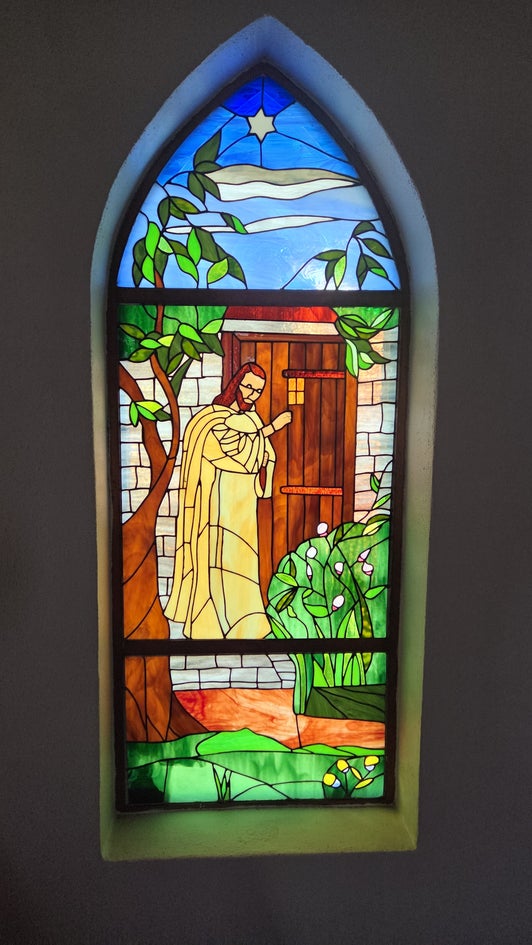
"The Glass"
Revelation 3:20 'Here, I’m standing at the door, knocking. If someone hears my voice and opens the door, I will come in to him and eat with him, and he will eat with me. '