

the 7 churches of Revelation : Jesus Knows

the 7 churches of Revelation :
Jesus Knows
B E Y O N D T H E S E R M O N Jesus Knows
The Seven Churches of Jesus · Series Finale
Revelation 2:1 – 3:22 · NIV
Seven churches. Seven different situations. Seven different messages. But one Lord walking among them all — and to every one of them He opens with the same two words: “I know.” This finale steps back from the individual letters to see the whole picture: who is speaking, why these seven were chosen, what pattern runs through every letter, and what Jesus might say if He wrote to our church today.
Use this guide on your own or with a group. Each Scripture reference is a live link to the passage on BibleGateway (NIV).
PART 1 The One Who Knows
Before a single letter is written, John sees the Author. In Revelation 1:12–20 the risen Christ stands “among the lampstands,” holding seven stars in His right hand, with eyes “like blazing fire.” Then He explains the vision Himself:
“The mystery of the seven stars that you saw in my right hand and of the seven golden lampstands is this: The seven stars are the angels of the seven churches, and the seven lampstands are the seven churches.”
— Revelation 1:20 (NIV)
Jesus is not writing to these churches from a distance. He is walking among them. That is why every letter can begin with “I know” — He has been there, seen it all, and missed nothing. In Thyatira He states it plainly, echoing Jeremiah 17:10:
“Then all the churches will know that I am he who searches hearts and minds, and I will repay each of you according to your deeds.”
— Revelation 2:23 (NIV)
|
GREEK WORD STUDY οἶδα oida Strong’s G1492 |
Meaning: “I know” — to know by having seen; full, settled knowledge. Oida is formed from the verb eidō, “to see.” It is a perfect-tense form used with a present meaning: “I have seen, and so I know.” Many scholars contrast it with ginōskō, which often describes knowledge gained step by step through experience. Oida describes knowledge that is already complete. Each of the seven letters opens with Oida (“I know your deeds,” Revelation 2:2). Jesus is not gathering information or forming an opinion. He already sees the whole truth — past the reputation, the attendance, and the programs, down to the heart (1 Samuel 16:7). |
|
GREEK / HEBREW WORD STUDY λυχνία luchnia · menorah G3087 · H4501 |
Meaning: “Lampstand” — a stand that holds and carries a light. The tabernacle’s golden menorah, מְנוֹרָה (Exodus 25:31–40) burned continually in the Holy Place, and Zechariah saw a golden lampstand fed “not by might nor by power, but by my Spirit” (Zechariah 4:2–6). John’s lampstands draw on that picture. A lampstand is not the light. It holds the light. The Church exists to carry Christ’s light into a dark place (Matthew 5:14–16). That is why the warning to Ephesus is so serious: “I will come to you and remove your lampstand from its place” (Revelation 2:5). A church can keep its building and lose its lampstand. |
The Seven “I Know” Statements
|
Church |
“I know . . .” |
Reference |
|
Ephesus |
“I know your deeds, your hard work and your perseverance.” |
|
|
Smyrna |
“I know your afflictions and your poverty—yet you are rich!” |
|
|
Pergamum |
“I know where you live—where Satan has his throne.” |
|
|
Thyatira |
“I know your deeds, your love and faith, your service and perseverance, and that you are now doing more than you did at first.” |
|
|
Sardis |
“I know your deeds; you have a reputation of being alive, but you are dead.” |
|
|
Philadelphia |
“I know your deeds. See, I have placed before you an open door that no one can shut.” |
|
|
Laodicea |
“I know your deeds, that you are neither cold nor hot.” |
Notice: to some churches “I know” is pure comfort (Smyrna, Philadelphia). To others it is a warning (Sardis, Laodicea). For most it is both. The same Lord who sees your hidden faithfulness also sees your hidden compromise.
PART 2 Why These Seven?
Historical Background
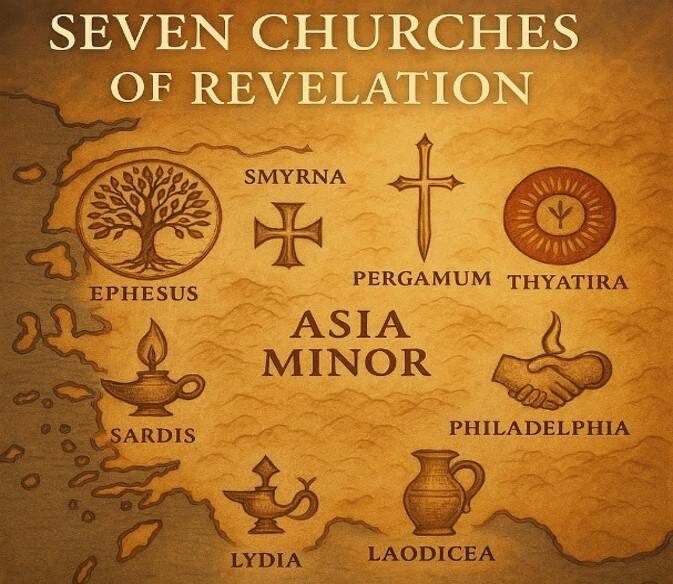
The seven cities sat in the Roman province of Asia, in what is now western Turkey. John received the Revelation in exile on Patmos (Revelation 1:9), traditionally dated about AD 95, under the emperor Domitian. The cities are listed in the order a messenger would travel: land at Ephesus, go north to Smyrna and Pergamum, then turn southeast through Thyatira, Sardis, and Philadelphia, and end at Laodicea. The route makes a rough horseshoe through the region.
These were not the only churches in the area, or even the most famous ones. Jerusalem was the mother church. Antioch was where believers were first called Christians and where Paul and Barnabas were sent out (Acts 11:26; Acts 13:1–3). Within a few miles of Laodicea were churches at Colossae and Hierapolis (Colossians 4:13–16). There were also believers at Troas and Miletus (Acts 20:5–17). Jesus chose these seven.
Why Seven?
Throughout Scripture, seven is the number of completeness. Creation was finished in seven days (Genesis 2:2–3), and Revelation is built on sevens: seals, trumpets, bowls. Seven churches give a complete picture of the Church. Every letter ends, “Whoever has ears, let them hear what the Spirit says to the churches” — plural. Each congregation was meant to hear all seven letters, and so are we.
The Anatomy of a Letter
Most of the letters follow the same seven-part pattern. Learning it makes the letters easier to read side by side.
|
Part |
What It Does |
Example (Ephesus) |
|
1. Address |
Names the church and its “angel” (messenger) |
“To the angel of the church in Ephesus write” (2:1) |
|
2. Christ’s Title |
A self-description drawn from the vision in Rev. 1 |
“Him who holds the seven stars . . . and walks among the seven golden lampstands” |
|
3. “I know” |
What Jesus sees, usually starting with commendation |
“Your deeds, your hard work and your perseverance” (2:2) |
|
4. Concern |
What Jesus holds against them |
“You have forsaken the love you had at first” (2:4) |
|
5. Counsel |
The command: remember, repent, hold on, wake up |
“Consider how far you have fallen! Repent” (2:5) |
|
6. Call to Hear |
“Whoever has ears, let them hear . . .” |
|
|
7. Promise |
A reward for the one who is victorious |
“The right to eat from the tree of life” (2:7) |
The Seven Letters Side by Side
|
Church |
Christ Reveals Himself As |
Commendation |
Concern |
Counsel |
Promise to the Victorious |
|
Ephesus 2:1– |
Holds the seven stars; walks among the lampstands |
Hard work, perseverance, tested false apostles |
Forsaken first love |
Remember, repent, do the first works |
Eat from the tree of life |
|
Smyrna 2:8– |
The First and the Last, who died and came to life |
Rich in affliction and poverty |
None |
Do not be afraid; be faithful to death |
Crown of life; not hurt by the second death |
|
Pergamum |
Has the sharp, double-edged sword |
Held to His name, even when Antipas was martyred |
Teaching of Balaam; Nicolaitans |
Repent |
Hidden manna; white stone with a new name |
|
Thyatira |
Son of God; eyes like blazing fire |
Love, faith, service, perseverance; growing works |
Tolerates “Jezebel” |
Hold on to what you have until I come |
Authority over the nations; the morning star |
|
Sardis 3:1–6 |
Holds the seven spirits of God and the seven stars |
A few have not soiled their clothes |
Reputation of life, but dead |
Wake up, strengthen, remember, obey, repent |
White garments; name kept in the book of life |
|
Philadelphia |
Holy and true; holds the key of David |
Kept My word with little strength |
None |
Hold on to what you have |
Pillar in God’s temple; new names written |
|
Laodicea |
The Amen, the faithful and true witness |
None |
Lukewarm; self-sufficient |
Buy gold, white clothes, salve; be earnest and repent |
Sit with Christ on His throne |
Observe: Smyrna and Philadelphia, the two churches with no rebuke, were both the poorest and weakest in worldly terms (Revelation 2:9; Revelation 3:8). Laodicea, the only church with no commendation, was the one that thought it needed nothing (Revelation 3:17).
PART 3 Three Ways to Read the Letters
This series has looked at the seven churches from three angles. The angles do not compete.
Together they show how much these letters hold.
|
Lens |
The Question It Asks |
What It Shows Us |
|
Historical |
What was happening in these real congregations around AD 95? |
Jesus speaks to real places, real pressures, and real people by name (Antipas, “Jezebel”). |
|
Thematic |
What spiritual conditions do these churches represent? |
Every church and every believer can drift toward one of these seven conditions. Several can exist in the same congregation at once. |
|
Lens |
The Question It Asks |
What It Shows Us |
|
Prophetic |
Do the seven, in order, picture the course of the Church Age? |
Many Bible teachers see the order of the letters matching the broad seasons of Church history, from the apostles to the last days. |
The Prophetic View: A Panorama of the Church Age
Many dispensational teachers (C. I. Scofield and Clarence Larkin are well known examples) have seen the seven letters as a preview of the Church Age, from Pentecost to the Rapture. The dates below are approximate and are offered as one lens, not as the main point of the letters.
|
Church |
Era (approx.) |
Season of the Church |
Connection in the Letter |
|
|
Ephesus |
AD 30–100 |
Apostolic Church |
Strong doctrine and labor, but first love already fading |
|
|
Smyrna |
100–313 |
Persecuted Church |
“Ten days” of persecution (2:10), often linked to the Roman persecutions before the Edict of Milan |
|
|
Pergamum |
313–590 |
State Church |
Living “where Satan has his throne.” The Church grows close to political power after Constantine |
|
|
Thyatira |
590–1517 |
Medieval Church |
Real works and devotion mixed with tolerated corruption |
|
|
Sardis |
1517–1750 |
Reformation Church |
Truth recovered, but at risk of a name without life |
|
|
Philadelphia |
1750–1900s |
Missionary Church |
An “open door” (3:8) as revivals and world missions spread the gospel |
|
|
Laodicea |
1900s– Rapture |
Last-Days Church |
Wealth, comfort, and self-sufficiency, with Christ outside knocking (3:20) |
|
|
PROPHETIC WORD STUDY “Until I come” Rev. 2:25 · 3:3 · 3:11 · 3:20 The last four letters |
Meaning: From Thyatira onward, each letter looks ahead to the Lord’s return. Thyatira: “Hold on to what you have until I come” (Revelation 2:25). Sardis: “I will come like a thief” (Revelation 3:3). Philadelphia: “I am coming soon” (Revelation 3:11). Laodicea: “I stand at the door and knock” (Revelation 3:20). In the prophetic view, the last four conditions continue side by side until Christ returns. Philadelphia is promised, “I will also keep you from the hour of trial that is going to come on the whole world” (Revelation 3:10). Right after the letters, John hears, “Come up here” (Revelation 4:1), and the word church does not appear again until Revelation 22:16. Premillennial readers see in this the Church’s removal before the Tribulation. |
|||
|
|
|
|
|
|
PART 4 Hearing What the Spirit Says
|
GREEK WORD STUDY λέγει legei Strong’s G3004 (present tense) |
Meaning: “Says” — present tense: the Spirit keeps on speaking. Seven times we read, “Whoever has ears, let them hear what the Spirit says to the churches” (Revelation 2:7). Jesus does not say said. The verb is present tense. These letters were not written only for the first century. The Spirit is still speaking them to churches today. The phrase echoes Jesus’ own teaching (Matthew 13:9; Matthew 13:43). Having ears is not the same as hearing. The call is to listen and respond. |
|
GREEK WORD STUDY νικάω nikaō Strong’s G3528 |
Meaning: “To overcome, conquer, be victorious” (root of nikē, victory). Every letter ends with a promise “to the one who is victorious.” Victory in Revelation doesn’t come from strength or numbers. It is faithfulness to Jesus, even to death (Revelation 12:11). John defines the overcomer in 1 John 5:4–5: “Who is it that overcomes the world? Only the one who believes that Jesus is the Son of God.” The promises are not for a spiritual elite. They belong to everyone who trusts Christ and keeps trusting Him. |
Jesus Outside His Own Church
“Here I am! I stand at the door and knock. If anyone hears my voice and opens the door, I will come in and eat with that person, and they with me.”
— Revelation 3:20 (NIV)
This verse is often used to invite unbelievers to Christ, and rightly so. But in context it is spoken to a church. Laodicea had everything except Jesus’ presence at the center. The invitation is personal (“if anyone hears”) and it is about relationship: the word for “eat” (deipneō) means sharing the main evening meal, the unhurried meal of friends. Just before this, Jesus says, “Those whom I love I rebuke and discipline” (Revelation 3:19). His rebuke is an act of love. He knocks because He still wants in.
PART 5 A Seven-Church Checkup
The sermon asked us to stop asking “Which church are they?” and start asking, “Jesus, what do You see when You look at us?” Take each question slowly. Write a short, honest answer for yourself and for our church.
|
Church |
Ask Honestly |
In My Life |
In Our Church |
|
Ephesus |
Am I still enjoying Jesus, or only working for Him? |
|
|
|
Smyrna |
Is pressure pushing me away from Jesus or deeper into Him? |
|
|
|
Pergamum |
Where have I made peace with something Jesus calls sin? |
|
|
|
Thyatira |
Am I calling something “love” that Jesus calls compromise? |
|
|
|
Sardis |
Am I living on yesterday’s reputation? |
|
|
|
Philadelphia |
What open door has Jesus placed before me? |
|
|
|
Laodicea |
What do I think I don’t need? |
|
|
PART 6 Questions for Reflection
- Jesus says “I know” to all seven churches. Does that truth comfort you or sober you more right now? Why?
- Read Revelation 2:2[1] and 1 Samuel 16:7. How do people usually measure a church? How does Jesus measure one?
- Ephesus had truth without love; Thyatira had love without boundaries. Which way do you tend to lean? How does Ephesians 4:15 bring the two together?
- Smyrna and Philadelphia were the weakest churches, yet they received no rebuke. What does that teach you about how Jesus defines strength? (See 2 Corinthians 12:[2].)
- In Revelation 3:20, Jesus stands outside the door of His own church. What might keep a church’s door closed to Him today?
- The Spirit “says,” in the present tense. What habits help you actually hear what He is saying, not just read the words?
- Imagine a letter from Jesus to Covington Community Church. What is one thing you think He would commend? What is one thing He might call us to change?
PART 7 For Further Study
|
Passage |
Focus |
|
The vision of Christ among the lampstands — the One who writes the letters |
|
|
“You have searched me, Lord, and you know me” — being fully known by God |
|
|
“I the Lord search the heart” — the Old Testament root of Rev. 2:23 |
|
|
Jesus “knew all people” and what was in each person |
|
|
“I know my sheep” — “The Lord knows those who are his” |
|
|
The sobering opposite: “I never knew you” |
|
|
Nothing in all creation is hidden from God’s sight |
|
|
Laodicea, Hierapolis, and Colossae; letters read among the churches |
|
|
Who the overcomer is |
|
|
Jesus’ final word “for the churches” — and the invitation, “Come!” |
[1] . The sermon suggested that all seven churches can be found inside the same congregation.
Where have you seen two or more of these conditions side by side?
[2] . The sermon closed with six requests: keep our love alive, faith strong, doctrine true, hearts awake, doors open, and fire burning. Which one do you need most this week? What step will you take?

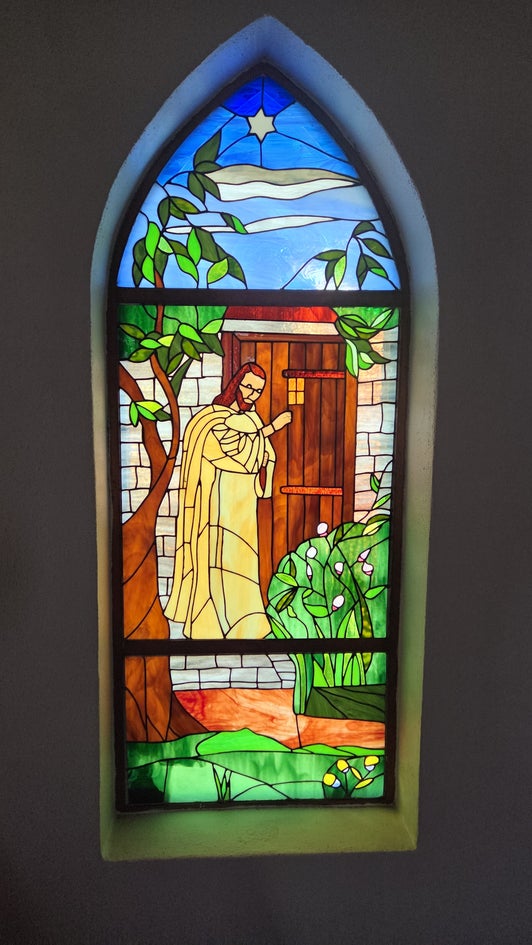
"The Glass"
Revelation 3:20 'Here, I’m standing at the door, knocking. If someone hears my voice and opens the door, I will come in to him and eat with him, and he will eat with me. '