

the 7 churches of Revelation : Laodicea part 2

the 7 churches of Revelation :
Laodicea: Temperature Matters, Part Two
|
BEYOND THE SERMON The Seven Churches of Jesus • Week Nine Laodicea: Open the Door Part Two • Revelation 3:19–22 |
This guide is designed to take you deeper than Sunday morning allowed. Work through it on your own, with a spouse, or with a small group. This is the final message in The Seven Churches of Jesus, so the last pages look back across all seven letters. Scripture quotations are from the NIV unless otherwise noted.
THE TEXT
|
¹⁹ “Those whom I love I rebuke and discipline. So be earnest and repent. ²⁰ Here I am! I stand at the door and knock. If anyone hears my voice and opens the door, I will come in and eat with that person, and they with me. ²¹ To the one who is victorious, I will give the right to sit with me on my throne, just as I was victorious and sat down with my Father on his throne. ²² Whoever has ears, let them hear what the Spirit says to the churches.” — Revelation 3:19–22 (NIV) |
WHERE WE LEFT OFF
In Part One (Revelation 3:14–18), Jesus exposed Laodicea’s true condition. The church thought it was rich, clothed and clear-sighted. Jesus said it was poor, naked and blind — and lukewarm, because it had stopped depending on Him. He counseled them to “buy from me.”
Now the tone turns. The same Jesus who diagnosed the problem moves from warning to invitation. The letter that begins with the harshest words in all seven letters ends with one of the most tender pictures in the Bible: Jesus knocking at a door, waiting to sit down at the table.
THE BIG IDEA
A church can keep all its activity and still have Jesus on the outside. But He has not walked away. His correction is proof of His love, His knock is proof of His patience, and His invitation is to a relationship, not just religion. The cure for a lukewarm church is not more programs. It is Jesus Himself.
|
Point One |
Point Two |
Point Three |
|
Jesus corrects the people He loves (v. 19) |
Jesus is still knocking (v. 20a) |
Jesus wants relationship, not just religion (v. 20b) |
The message closes with the promise to the overcomer (v. 21) and a searching question: Is Jesus inside or outside?
HISTORICAL & CULTURAL BACKGROUND
A Door on a Church
Revelation 3:20 is often used as an invitation to salvation, and it can rightly be applied that way — “if anyone” is wide open. But in context, Jesus is speaking to a congregation that already existed, already gathered and already called itself His. The door is on the church. That is what makes the picture so sobering: the people were still meeting, but the Lord of the church was on the outside.
The Meaning of a Shared Meal
The word Jesus uses for “eat” refers to the deipnon, the main evening meal of the day. It was not a quick bite on the road. It was the long, unhurried meal where families and friends lingered, talked and shared life. In the ancient Near East, to eat with someone meant acceptance, peace and fellowship. That is why the Pharisees were so offended that Jesus ate with tax collectors and sinners (Luke 15:1–2), and why a shared meal with Zacchaeus changed everything (Luke 19:5–10).
|
An echo from Jesus’ own teaching. In Luke 12:36–37, Jesus told of servants waiting for their master to return so that “when he comes and knocks they can immediately open the door for him.” Then comes a stunning reversal: the master “will dress himself to serve, will have them recline at the table and will come and wait on them.” The Lord who knocks is also the Lord who serves. |
The Painting with No Handle
In 1853 the English artist William Holman Hunt completed The Light of the World, a painting of Jesus holding a lantern and knocking at an overgrown door. Viewers have long noticed that the door has no handle on the outside, and the painting is often explained this way: the door can only be opened from within. The painting became one of the best-known religious images in the English-speaking world, and it captures the heart of verse 20 well. Jesus has authority to break in, but He knocks.
WORD STUDIES
|
φιλέω phileō — “to love as a friend, to hold dear” “Those whom I love…” Jesus uses the warm word for affection and friendship. It is the same word used of Jesus’ love for Lazarus (“the one you love is sick,” John 11:3). Verse 19 echoes Proverbs 3:11–12: “the LORD disciplines those he loves, as a father the son he delights in.” Why it matters: The hardest letter of the seven is framed by affection. The rebuke comes from a friend, not an enemy. |
|
ἐλέγχω elenchō — “to expose, convict, bring to light” Translated “rebuke,” this word means more than scolding. It means to bring something into the light so it can be seen for what it is. Jesus used it of the Holy Spirit’s work: “he will prove the world to be in the wrong about sin” (John 16:8). Paul used it in Ephesians 5:11–13: “everything exposed by the light becomes visible.” Why it matters: Laodicea could not see its condition (v. 17). Rebuke is Jesus turning on the light. |
|
παιδεύω paideuō — “to train, instruct, discipline a child” Translated “discipline,” this word comes from pais, “child.” It describes the training a father gives a son, not a sentence a judge hands a criminal. It is the word used in Hebrews 12:6: “the Lord disciplines the one he loves.” Why it matters: Discipline is family language. It is how God treats sons and daughters (Heb. 12:7–8). |
|
ζηλεύω zēleuō — “be zealous, be earnest” This verb appears only here in the New Testament. It is related to zēlos (zeal), and both come from the idea of boiling. Many commentators have noticed the connection to verse 15, where Jesus wished they were zestos — “hot.” The cure for a lukewarm church is a church brought back to the boil. Why it matters: “Be earnest” is Jesus answering His own diagnosis. Lukewarm is the problem; zeal is the remedy. |
|
μετανοέω metanoeō — “to change the mind, turn around” From meta (after, change) and noeō (to think). Repentance is a change of mind that leads to a change of direction — the Old Testament picture of shuv (שׁוּב), “to turn back.” Jesus calls five of the seven churches to repent (Ephesus, Pergamum, Thyatira, Sardis and Laodicea). Why it matters: As the sermon put it, “Repentance is not punishment. Repentance is the road home.” |
|
ἕστηκα … κρούω hestēka … krouō — “I stand … I knock” Hestēka is in the perfect tense, which describes a completed action with continuing results: “I have taken My stand, and I remain standing.” Krouō is in the present tense: “I am knocking” — and keep on knocking. The sentence opens with idou (“Look!” or “Here I am!”), a word meant to grab attention. Why it matters: Jesus did not knock once and leave. He took His place at the door and is still there. |
|
δειπνέω deipneō — “to dine, share the evening meal” From deipnon, the main meal of the day. It is the same word used for the Lord’s Supper (1 Cor. 11:20, “the Lord’s Supper”) and for “the wedding supper of the Lamb” (Rev. 19:9). Notice the order: “I will eat with that person, and they with me.” The fellowship goes both ways. Why it matters: Jesus is not asking to inspect the house. He is asking to sit at the table. |
|
νικάω nikaō — “to conquer, overcome, be victorious” The root of nikē, “victory.” Every one of the seven letters closes with a promise to “the one who is victorious” (the older translations say “him that overcometh”). John defines the overcomer in 1 John 5:4–5: “this is the victory that has overcome the world, even our faith… Only the one who believes that Jesus is the Son of God.” Why it matters: Overcoming is not earned by our strength. It is Christ’s victory shared with those who trust Him (v. 21, “just as I was victorious”). |
REJECTION OR CORRECTION?
The sermon said, “Correction is not always rejection. Sometimes correction is evidence that God has not given up on us.” Scripture draws a clear line between the two:
|
|
Punishment / Rejection |
Loving Discipline |
|
Purpose |
To pay back a wrong |
To restore and train (Heb. 12:10–11) |
|
Relationship |
Judge to offender |
Father to child (Prov. 3:11–12) |
|
Focus |
The past |
The future — “a harvest of righteousness” |
|
Feeling |
Condemnation |
Conviction, which leads to hope (2 Cor. 7:10) |
|
What it proves |
Distance |
Belonging — “God is treating you as his children” (Heb. 12:7) |
RELIGION OR RELATIONSHIP?
Laodicea had all the outward marks of a working church. What it lacked was closeness with Jesus. The sermon’s contrasts are worth sitting with:
|
Laodicea Had… |
What It Lacked… |
Where We Can Drift Today |
|
Religion |
Intimacy |
Knowing church language but losing closeness with Jesus |
|
Activity |
Closeness |
Knowing the songs but no longer worshiping |
|
Resources |
Dependence |
Knowing the Scripture but no longer listening |
|
Church |
Communion |
Serving in ministry while becoming spiritually distant |
|
“If your Presence does not go with us…” After Israel’s sin with the golden calf, God offered to send an angel ahead of them into the Promised Land — but said He would not go with them Himself (Exod. 33:2–3). Moses refused the deal: “If your Presence does not go with us, do not send us up from here” (Exod. 33:15). Moses would rather stay in the wilderness with God than enter the land without Him. As the sermon said, that should be the prayer of every church: “Lord, if You are not in it, we do not want it.” |
THE THRONE PROMISE
Laodicea receives the most exalted promise of all seven letters: “the right to sit with me on my throne.” It is given to the church that seemed least deserving of it. As the sermon put it, “Their current condition did not have to become their final condition.”
Notice that verse 21 describes two thrones. Jesus says He “sat down with my Father on his throne” — His present place at the Father’s right hand since His ascension (Heb. 1:3; 12:2). But He also speaks of “my throne,” which believers will share. Scripture connects this to the reign of Christ that follows His return:
|
Passage |
What It Says |
|
Matthew 19:28 |
“When the Son of Man sits on his glorious throne, you who have followed me will also sit on twelve thrones.” |
|
Luke 1:32–33 |
“The Lord God will give him the throne of his father David… his kingdom will never end.” |
|
2 Timothy 2:12 |
“If we endure, we will also reign with him.” |
|
Revelation 5:10 |
“You have made them to be a kingdom and priests to serve our God, and they will reign on the earth.” |
|
Revelation 20:4–6 |
Those who belong to Christ “reigned with Christ a thousand years.” |
From a premillennial perspective, this throne is not only a figure of speech. When Christ returns, He will reign on the earth from the throne of David for a thousand years, and His people will reign with Him. The lukewarm church is invited to share in that reign — if they will open the door.
THREE DOORS IN REVELATION
Doors appear three times in a row in Revelation, and together they tell a story:
|
Reference |
The Door |
Who Opens It |
|
Revelation 3:8 |
An open door set before Philadelphia |
Jesus opens — “no one can shut” it |
|
Revelation 3:20 |
A closed door on the church at Laodicea |
We open — Jesus knocks and waits |
|
Revelation 4:1 |
“A door standing open in heaven” |
God opens — and a voice says, “Come up here” |
Revelation 4:1 is the turning point of the whole book. Chapters 1–3 have covered “what is now” — the churches (compare 1:19). After chapter 4, John sees “what must take place after this,” and the Church is not mentioned again on earth until the end of the book. Many dispensational interpreters see John’s being called up through the open door as a picture of the Church being caught up to meet the Lord (1 Thess. 4:16–17) before the judgments that follow. Whatever one’s view of the details, the order is striking: the last word to the churches is an invitation to open the door, and the next thing we see is a door opened in heaven.
LOOKING BACK: THE SEVEN CHURCHES
The sermon summed up the whole series in one line: “Ephesus could return. Pergamum could repent. Thyatira could hold fast. Sardis could wake up. Laodicea could open the door.” Here is the whole journey in one place:
|
Church |
Jesus’ Call |
Condition |
Promise to the Overcomer |
|
Ephesus (2:1–7) |
Remember, repent, return to your first love |
Loveless |
Eat from the tree of life in the paradise of God |
|
Smyrna (2:8–11) |
Be faithful, even to the point of death |
Suffering but rich |
The crown of life; not hurt by the second death |
|
Pergamum (2:12–17) |
Repent of compromise |
Compromising |
Hidden manna and a white stone with a new name |
|
Thyatira (2:18–29) |
Hold on to what you have |
Tolerating what is harmful |
Authority over the nations and the morning star |
|
Sardis (3:1–6) |
Wake up and strengthen what remains |
Asleep |
White clothes; name never blotted from the book of life |
|
Philadelphia (3:7–13) |
Hold on to what you have |
Faithful with little strength |
A pillar in God’s temple, marked with God’s name |
|
Laodicea (3:14–22) |
Be earnest, repent, open the door |
Lukewarm |
To sit with Christ on His throne |
|
Failure does not have to be final. Five of these seven churches received correction. Every one of the seven received a promise. The letters were not written to shame the churches but to call them back. “Drift does not have to become destiny. Lukewarm does not have to remain lukewarm. The fire can burn again.” |
REFLECTION QUESTIONS
Point One — Jesus Corrects the People He Loves
1. Read Hebrews 12:5–11. How does knowing that correction comes from love change the way you respond when God convicts you about something?
2. The sermon said, “Sometimes conviction is grace.” Think of a time God made you uncomfortable in a way that turned out to be for your good. What did you learn?
3. “Be earnest” is Jesus’ answer to “lukewarm.” What is one area of your faith that has become casual or halfhearted, and what would being earnest look like there?
4. Repentance was described as “the road home.” Is there anything you sense God calling you to turn back from right now?
Point Two — Jesus Is Still Knocking
5. Jesus is standing outside the door of a church, not a pagan temple. How is it possible for a church to keep meeting while Jesus is on the outside? What might the warning signs be?
6. Jesus knocks instead of kicking the door down. Why do you think He wants a willing response rather than forcing His way in?
7. “If anyone…” means one person can respond even when a whole church is lukewarm. Why does revival so often begin with “I need” instead of “The Church needs”?
Point Three — Relationship, Not Just Religion
8. Look at the “Religion or Relationship?” table. Which of the four drifts do you recognize most in your own walk with Jesus?
9. Jesus wants access to your decisions, relationships, priorities, plans, fears and hopes. Which of these is the hardest for you to open to Him, and why?
10. Read Exodus 33:12–16. What would it look like for our church to say, “Lord, if You are not in it, we do not want it”?
The Promise and the Door
11. Laodicea — the church that seemed least deserving — received the greatest promise. What does that tell you about the heart of Jesus toward people who have drifted?
12. Looking back over all seven churches, which letter has spoken to you most during this series, and what has God been asking you to do in response?
13. Is Jesus inside or outside in your life right now? Write out, in your own words, what it would mean for you to “hear the knock” and “open the door” this week.
FURTHER STUDY
|
Passage |
Connection to Laodicea |
|
Proverbs 3:11–12 |
The passage behind Revelation 3:19: the LORD disciplines those He loves. |
|
Hebrews 12:5–11 |
Discipline as proof of sonship and the path to “a harvest of righteousness and peace.” |
|
Song of Songs 5:2–6 |
The beloved knocks — “Open to me” — but the door is opened too late. A picture of delayed response. |
|
Luke 12:35–38 |
Servants ready to open the door when the master knocks; the master then serves them at the table. |
|
Luke 19:1–10 |
Zacchaeus welcomes Jesus into his home, and a meal becomes the doorway to salvation. |
|
John 14:21–23 |
“My Father will love them, and we will come to them and make our home with them.” |
|
Exodus 33:12–17 |
Moses refuses to go forward without the presence of God. |
|
Psalm 85:6 |
“Will you not revive us again, that your people may rejoice in you?” |
|
2 Corinthians 7:8–11 |
The difference between godly sorrow that leads to repentance and worldly sorrow. |
|
Revelation 19:6–9 |
The wedding supper of the Lamb — the table fellowship of Revelation 3:20 made complete. |
CLOSING THE SERIES
For nine weeks we have walked among the lampstands with Jesus. We started with His right to speak to His Church — He is its Founder, Foundation and Chief Cornerstone — and we end with Him standing at the door. Between those two pictures, He has spoken to seven very different churches with the same heart: He knows, He corrects, He calls and He promises.
The letters were written to real congregations in the first century, but they end the same way every time, because they were written for us too. Before you close this guide, read all of Revelation 2–3 in one sitting and ask: Which of these churches sounds most like me?
“Whoever has ears, let them hear what the Spirit says to the churches.” — Revelation 3:22
Scripture quotations taken from The Holy Bible, New International Version®, NIV®. Copyright © 1973, 1978, 1984, 2011 by Biblica, Inc.™ Used by permission of Zondervan. All rights reserved worldwide.

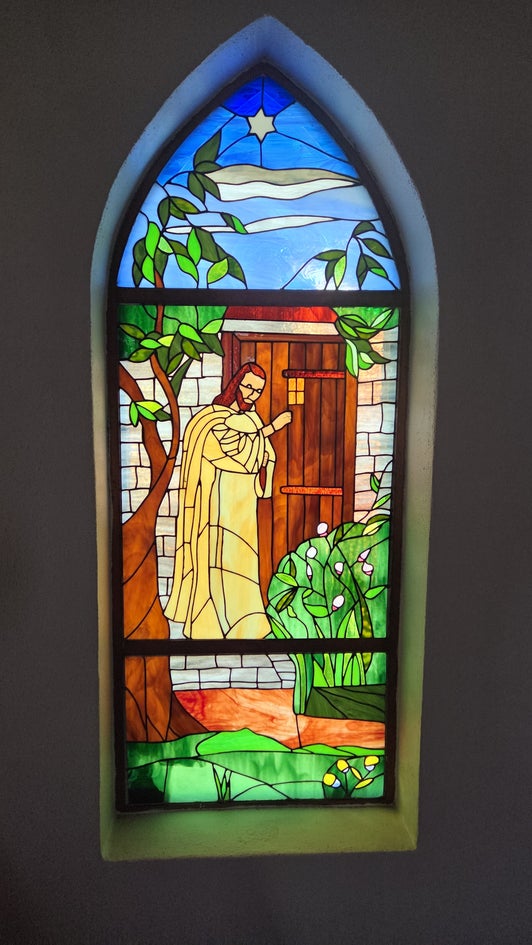
"The Glass"
Revelation 3:20 'Here, I’m standing at the door, knocking. If someone hears my voice and opens the door, I will come in to him and eat with him, and he will eat with me. '