


THE ARMOR OF GOD
Week Five • Above All, Take Up
The Shield of Faith
Ephesians 6:16
Beyond the Sermon Workbook
Pastor Rod Meyers • Covington Community Church
All scripture quotations from the New International Version (NIV) unless noted. Verse references are linked to BibleGateway.
|
“In addition to all this, take up the shield of faith, with which you can extinguish all the flaming arrows of the evil one.” |
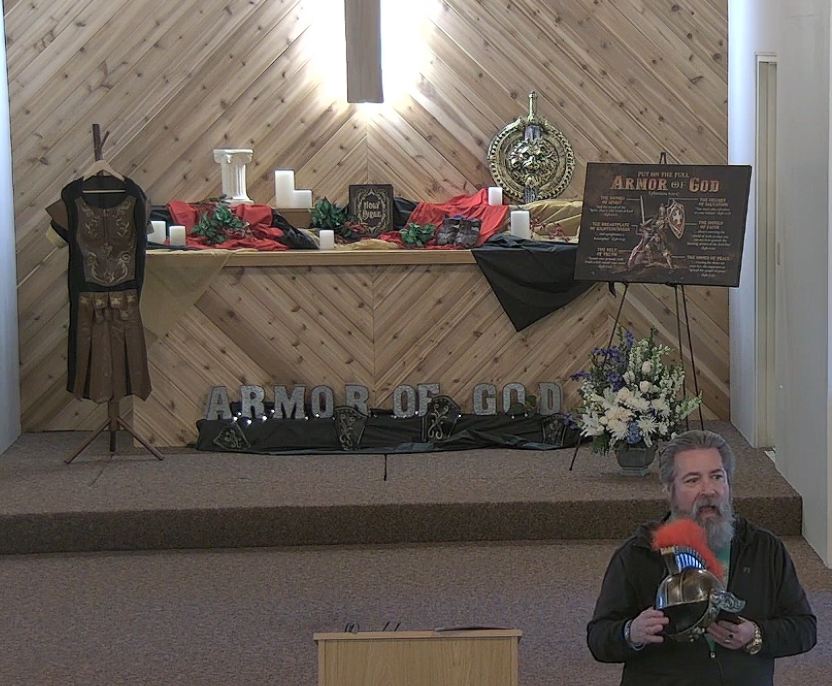
Pastor Rod pointed at the shield on the display table and said, in effect, “not that one.” The shield Paul had in mind was the size of a door. Soldiers soaked it in water before a siege, locked it edge-to-edge with the shields beside them, and drilled until a chariot could roll across the top of the formation. That is the picture behind the fourth piece of armor — and, Paul says, it is the one to take up above all. This workbook digs into the Greek behind “shield,” “faith,” “quench,” and “able”; the Roman scutum and the tortoise formation; what a fiery dart actually was; and the long roll call of Hebrews 11 that shows what taking up the shield looks like in a real life.
How to use this workbook: Read each section with your Bible open. Click any reference to read it in full. Write your answers in the space provided — the goal is not to finish quickly but to think clearly.
1. The Sermon in Brief
Pastor Rod began with a definition of leadership he heard the day before from a young man named Tom while praying over a piece of property in Georgetown for a new ministry: leadership is leading. Faith is like that. People preach whole series on it, but the simple definition is this — faith is believing. Every time you see the word faith, substitute believing or trust. Faith is believing the One who gave the promises.
From there the message moved through the Roman shield and what faith does when you take it up. Key points:
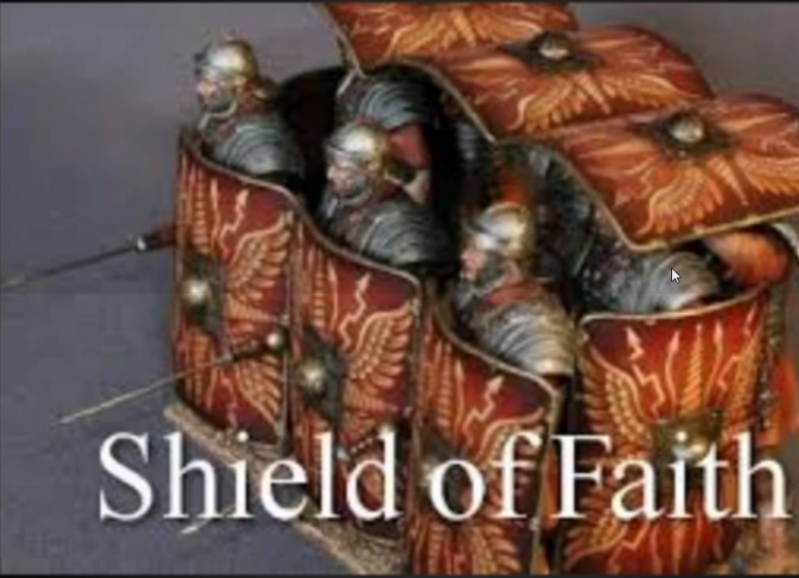
- The Roman shield was door-sized, made of wood and leather, covered with cloth and soaked in water so fiery darts would go out on impact. In the tortoise formation, shields locked together protected the whole unit — a picture of a congregation standing behind its faith together.
- The seven sons of Sceva used the name of Jesus without believing in Jesus, and the demons knew the difference (Acts 19:13-16). Belief is what gives the shield its power.
- The KJV reads “wherewith ye shall be able” — the Greek word behind “able” is dunamai, kin to dunamis, dynamite. Taking up the shield of faith dynamically empowers you to stand.
- Doubt is a fiery dart. Adam and Eve had no faith in what God had said, and they fell to “did God really say?” (Genesis 3:1-6).
- Jesus quenched the enemy’s darts in the wilderness with the memorized Word (Matthew 4:1-11). The Word and prayer build the shield.
- Jesus cared about faith, not ritual. Faith moves mountains (Matthew 17:20 — the key verse of this ministry), answers prayer (Matthew 21:22), and heals (Matthew 9:27-30).
- The LORD Himself is the shield behind the shield (Genesis 15:1; Psalm 3:3; 1 Peter 1:5).
- Hebrews 11 and 12: the heroes of the faith did not see the promises fulfilled but believed anyway; a cloud of witnesses watches us run our race; Jesus is the Pioneer and Perfecter of our faith (Hebrews 12:1-3).
- Be a spiritual battle tank. An old tank is still a tank.
2. Word Studies
Paul’s Greek in Ephesians 6:16 is precise. He did not pick the ordinary word for shield, and the verb for “extinguish” describes exactly what a water-soaked shield does to a burning arrow.
|
Greek: θυρεός (thyreos) — “the door-shield” |
|
This is the only place the word appears in the New Testament, and Paul chose it deliberately. Greek had a common word for a small round shield (aspis). Thyreos comes from thyra, “door” — it means the large oblong shield that covered a man from shoulder to shin. The Romans called it the scutum. Paul is not describing something you hold up in front of your face. He is describing something you stand behind entirely. The Old Testament makes the same distinction. The Hebrew magen is the ordinary shield (Genesis 15:1; Psalm 3:3); the tsinnah is the large full-body shield. In Psalm 91:4 God’s faithfulness is both — “his faithfulness will be your shield [tsinnah] and rampart.” The big shield is God’s own faithfulness, and faith is how you get behind it. |
|
Greek: πίστις (pistis) — “faith, trust, belief” |
|
From peithō, “to persuade, to be persuaded.” Pistis is settled confidence in someone — being persuaded that they are reliable. In the New Testament it almost always has an object: faith in God, faith in Christ. Pastor Rod’s rule holds up in the Greek: read pistis as trust or believing and you will rarely go wrong. Note that Paul does not say “take up faith” but “the shield of faith.” Faith is not the shield’s material; it is what the shield is made of and what it does. Peter says the same: through faith we are “shielded by God’s power” (1 Peter 1:5). Faith is the hand that holds what God provides. |
|
Greek: σβέννυμι (sbennymi) — “to quench, to put out” |
|
The word for extinguishing a fire, a lamp, or a flame — the same word Isaiah uses of the smoldering wick the Servant will not snuff out (quoted in Matthew 12:20), and the word Paul uses when he warns, “Do not quench the Spirit” (1 Thessalonians 5:19). Applied to a burning arrow it means what Pastor Rod said: to drown, to put out by water. The point is not that the dart never reaches you. Paul says you will extinguish it — which means it lands. Faith does not prevent the attack; it makes the attack go out on contact instead of exploding. |
|
Greek: δύναμαι (dynamai) — “to be able, to have power” |
|
This is the word the KJV renders “ye shall be able.” It is the verb form of dunamis — power, might, the root of our word dynamite. Paul is not saying faith might help. He is saying that with the shield up, you will have the power to put out every one of the enemy’s darts — “all” of them, not most. Hebrew offers a parallel worth knowing. Emunah — “faithfulness, steadfastness” — is from the root aman, to be firm (the same root as amen and emet, the belt of truth). “The righteous person will live by his faithfulness” (Habakkuk 2:4), quoted three times in the New Testament (Romans 1:17; Galatians 3:11; Hebrews 10:38) — and the launching point for Hebrews 11. |
3. Historical Background: The Scutum and the Tortoise
The Shield
The Roman scutum of Paul’s day was a curved rectangle roughly four feet tall and two and a half feet wide — Pastor Rod’s comparison to a door is not far off. It was built of thin strips of wood glued in layers at right angles (an early plywood), covered in leather or linen, bound at the edges with metal, and centered on an iron boss (umbo) that protected the hand and could be used to punch. It weighed around twenty pounds. A soldier could kneel behind it and disappear.
Before battle, especially in siege conditions, soldiers wetted the leather and cloth covering. A flaming missile that struck a dry shield could set it alight; struck a soaked one, it hissed out. This is the detail Paul reaches for when he says the shield can extinguish — not merely deflect — the enemy’s darts.
The Testudo
The tortoise formation (testudo) was a shield drill: the front rank held shields forward, the flanks held them outward, and the interior ranks raised theirs overhead, overlapping like scales. The result was a mobile armored box that could advance under a hail of arrows or approach a wall under fire. Roman writers record that a chariot could be driven over a well-formed testudo. Pastor Rod noted the word behind another Roman formation, the phalanx, gives us phalanges — the bones of the fingers — because the ranks stood like fingers side by side.
No soldier could form a testudo alone. The shield protected him individually, but its full power came when it locked with the shields on either side. Paul writes to a church, and the “you” in Ephesians 6 is plural. The shield of faith is meant to be raised together.
The Fiery Darts
Roman and enemy armies both used incendiary missiles. The Latin malleolus (“little hammer”) was an arrow or javelin with a hollow head packed with pitch, sulfur, or oil-soaked tow, lit and fired. On impact the head shattered and the burning contents splashed. Pastor Rod’s description was exact: they looked almost harmless in flight, and then they exploded on the man they hit. Larger versions were fired from siege engines with enough force to punch through a shield outright — which is why the formation mattered as much as the shield.
4. Naming the Darts
Pastor Rod named doubt as the first dart. The enemy has a small quiver, and the darts are recognizable once you have seen them. Use this table to identify what has been fired at you — and what belief quenches it.
|
The dart |
How it lands |
What quenches it |
|
Doubt — “Did God really say?” |
Second-guessing a clear call: the trip, the building, the investment, the person to help |
God’s Word does not fail (Isaiah 55:10-11; Numbers 23:19) |
|
Fear — “What if it goes wrong?” |
Reluctance to go; sleepless what-ifs; shrinking the vision |
The LORD is your shield; do not be afraid (Genesis 15:1; Isaiah 41:10) |
|
Accusation — “You’re disqualified” |
Old sin replayed; a sense that God is done with you |
No condemnation in Christ; the accuser is thrown down (Romans 8:1; Revelation 12:10-11) |
|
Temptation — lust of the eyes, lust of the flesh, pride of life |
Something that looks harmless until it explodes |
The written Word, spoken back (Matthew 4:4; 1 John 2:15-17) |
|
Discouragement — “Nothing is changing” |
Weariness; losing heart; wanting to quit the race |
Consider Him who endured (Hebrews 12:3; Galatians 6:9) |
|
Distrust of God’s goodness — “He is holding out on you” |
Resentment; taking matters into your own hands |
He rewards those who seek Him (Hebrews 11:6; Psalm 84:11) |
4a. Which dart has hit you most often this year? Which belief — with a verse — puts it out?
5. Three Case Studies
The Name Without the Faith: Acts 19
Read Acts 19:13-20. Seven sons of a Jewish chief priest tried to cast out a demon by “the Jesus whom Paul preaches.” The demon’s reply is chilling and instructive: “Jesus I know, and Paul I know about, but who are you?” They had the vocabulary of faith without the shield of faith, and they were overpowered. The result in Ephesus — the very church Paul later wrote Ephesians 6 to — was that the name of Jesus was held in high honor and people burned their sorcery scrolls. Ephesian believers who first read “the shield of faith” had watched what happens without it.
The Dart That Landed: Genesis 3
Adam and Eve were perfect, Pastor Rod said, but we do not see faith in them. Read Genesis 3:1-6 and watch the dart: a question that bends God’s word, a denial of consequence, and a suggestion that God is withholding something good. They had no shield up. They took the enemy’s word over God’s. Pastor Rod was careful not to condemn them — we are their children and fall to the same three temptations (1 John 2:16) — and noted that later they did trust God, at a critical time. But the first dart of history was doubt, and it exploded.
The Dart Extinguished: Matthew 4
Read Matthew 4:1-11. Fresh from His baptism — mikvahed into ministry at thirty, the age a priest began to serve (Numbers 4:3) — Jesus is led into the wilderness and fired on three times. Notice the pattern: each dart is answered with “It is written.” No scroll, no Bible; He had it memorized. Twice the devil quotes Scripture himself, and Jesus answers Scripture with Scripture rightly understood. The third time He says, “Away from me, Satan!” — and the devil leaves. That is what a raised shield does. Nobody is too holy to be tempted; the question is whether the shield is up.
5a. Jesus answered every dart with a memorized verse. What three verses do you have ready — right now, without looking — for the darts you named in Section 4?
6. What Jesus Said About Faith
|
“…Truly I tell you, if you have faith as small as a mustard seed, you can say to this mountain, ‘Move from here to there,’ and it will move. Nothing will be impossible for you.” |
This is the key verse of Covington Community Church’s ministry, and Pastor Rod dwelt on it. A mustard seed is not much faith; it is very little faith. But that is all it takes to move a mountain, to move a community, and to move a person from a life of sin to a life with Him. His father used to say: it is not how much faith it takes to save, but how little — believing on His name.
- Faith answers prayer. “If you believe, you will receive whatever you ask for in prayer” (Matthew 21:22; compare Mark 11:22-24; James 1:5-8). Pray like you believe — it is part of the shield.
- Faith heals. Two blind men (Matthew 9:27-30), the centurion’s servant (Matthew 8:5-13), the boy with the unclean spirit — “everything is possible for one who believes” (Mark 9:14-29). Pastor Rod testified to healings in Nigeria that a conference of 10,000 attributed, by name, to prayer from this congregation.
- Faith, not ritual, is what Jesus looks for. How pious we look in the pew, how we fast, how we take communion — these are not what He will ask about. He will ask: did you believe Me, did you trust My promises, when did you call on Me? (Matthew 8:10; Luke 18:8; Matthew 23:23).
6a. What mountain are you facing that you have stopped praying about because it seemed immovable? Write it down, and write the mustard-seed prayer next to it.
7. The Heroes of the Faith
|
“Now faith is confidence in what we hope for and assurance about what we do not see.” |
Read Hebrews 11:1-6. Pastor Rod noted that faith often has an invisible quality — like gravity, like the air — but that makes it no less real. By faith we understand that the universe was formed at God’s command, so that what is seen was not made out of what was visible. Faith deals in things that are real before they are visible. The patriarchs did not see the promises fulfilled; they are seeing them now, through us.
Each name in Hebrews 11 is a lesson in leadership, ministry, and trust. Here are a few, with what they could not see and what they believed anyway:
|
Hero |
What they could not see |
What they believed |
Read |
|
Abel |
Why his offering would be received |
That God is worth the best |
|
|
Noah |
Rain, let alone a flood |
A warning about things not yet seen |
|
|
Abraham |
Where he was going; the promised son for 25 years |
That God keeps His word — credited as righteousness; called God’s friend |
|
|
Sarah |
How a barren woman could bear |
That He who promised was faithful |
|
|
Moses |
The reward beyond Egypt’s treasures |
That the reproach of Christ was greater wealth |
|
|
Rahab |
How a Canaanite could be spared |
That the God of Israel is God in heaven and on earth |
|
“And without faith it is impossible to please God, because anyone who comes to him must believe that he exists and that he rewards those who earnestly seek him.” |
Pastor Rod pointed out that even an atheist has faith in his belief, and even the demons believe God is God and tremble (James 2:19). Our faith goes deeper: we believe God is able to keep His promises and that His Word has power. That is what makes a believer a stick of dynamite on the battlefield.
The Cloud of Witnesses
|
“fixing our eyes on Jesus, the pioneer and perfecter of faith. For the joy set before him he endured the cross, scorning its shame, and sat down at the right hand of the throne of God.” |
Read Hebrews 12:1-3. The “therefore” gathers up the whole chapter. Because of that cloud of witnesses — who, Pastor Rod noted, have not received their full reward until we receive ours (Hebrews 11:39-40) — we throw off what hinders and run. They are watching us run our race: parents, grandparents, generations back, the apostles. And the race is run behind the shield, with our eyes fixed on the One who is the lead of every example. It is not blind faith. Blind faith drinks the Kool-Aid; faith in Jesus sees a man on the throne of God who is one of us. Consider Him, so you will not grow weary and lose heart.
7a. Who in your own “cloud of witnesses” — a parent, grandparent, mentor — ran a race of faith you are still benefiting from? What did they believe that they never saw?
8. Reflection Questions
1. The KJV says “above all” take up the shield. Why might faith be the piece that matters most — and what happens to the other pieces without it?
2. Paul says you will extinguish the darts, not that they will never reach you. How does that change the way you interpret an attack when it lands?
3. The tortoise only works when every shield locks with the next. Whose shield is locked with yours? Whose faith have you strengthened lately, and who has strengthened yours? (Pastor Rod described being prayed over by a men’s fellowship the day before and going to Nigeria strengthened by their faith.)
4. Faith is believing the One who gave the promises. Name one promise of God you are actively standing on this month. Where is it written?
5. “An old tank is still a tank.” Where have you let age, season, or past failure convince you that you are no longer on the battlefield?
6. Jesus will not ask how pious you looked; He will ask whether you believed Him. If you had to answer today, what would you say?
9. This Week: Shield Drill
Roman soldiers practiced the tortoise until they could form it under fire. Faith is exercised the same way — daily, deliberately. Each day this week, record the dart, the promise you raised against it, and whom you locked shields with.
|
Day |
Dart fired at me |
Promise I raised (verse) |
Locked shields with |
|
Mon |
|
|
|
|
Tue |
|
|
|
|
Wed |
|
|
|
|
Thu |
|
|
|
|
Fri |
|
|
|
|
Sat |
|
|
|
|
Sun |
|
|
|
10. For Further Study
Read these passages during the week. Each one develops a thread from the message.
- Psalm 91 — His faithfulness a shield and rampart; the arrow that flies by day.
- Psalm 18:1-3, 30-36 — The LORD is my shield; the shield of Your salvation.
- Deuteronomy 33:26-29 — Israel saved by the LORD, her shield and helper.
- Habakkuk 2:1-4 — The righteous will live by faith; wait for the vision.
- Romans 4:16-25 — Abraham, fully persuaded that God had power to do what He promised.
- Romans 10:17 — Faith comes from hearing the message of Christ. This is how the shield is built.
- 2 Corinthians 5:6-9 — We live by faith, not by sight.
- 1 Peter 5:8-9 — Resist the devil, standing firm in the faith.
- 1 John 5:4-5 — The victory that overcomes the world: our faith.
- Hebrews 11:7-40 — The full roll call.
Next week: The Helmet of Salvation — Ephesians 6:17