



THE ARMOR OF GOD
Week Six • Put On Jesus
The Helmet of Salvation
Ephesians 6:17a
Beyond the Sermon Workbook
Pastor Rod Meyers • Covington Community Church
All scripture quotations from the New International Version (NIV). Verse references are linked to BibleGateway.
|
“Take the helmet of salvation and the sword of the Spirit, which is the word of God.” |
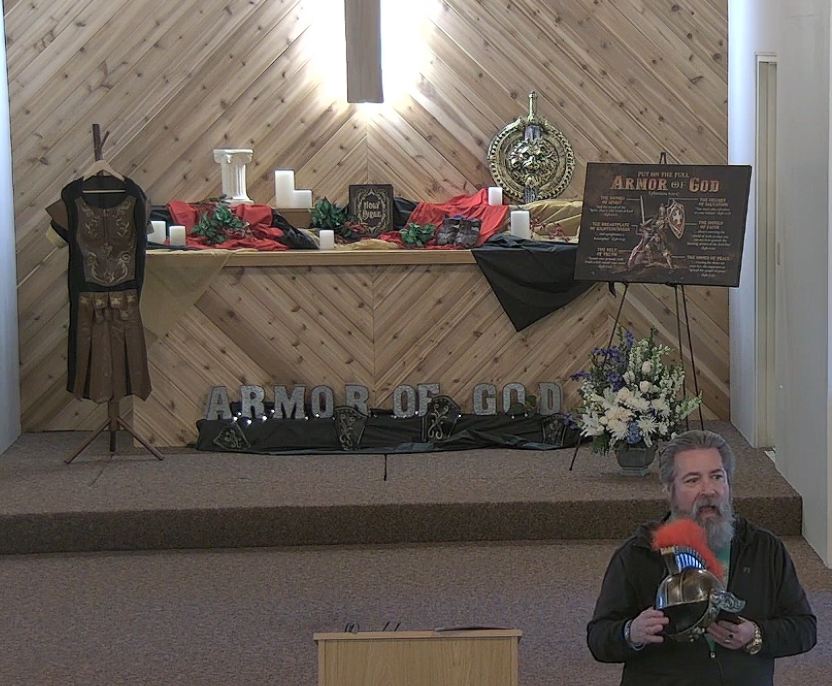
Four helmets on the platform: a Marine steel pot with a liner and a few stains, a motorcycle skid lid, a replica Roman centurion’s helmet, and a kippah from a Jerusalem marketplace. Pastor Rod used all four to make one point. The helmet goes on last, and if the head is not protected nothing else matters. Then he turned the kippah over and read what he had written on it — salvation — and reminded us that the Hebrew word for salvation is Yeshua. To put on the helmet of salvation is to put on Jesus. This workbook goes deeper into the Greek and Hebrew behind “helmet” and “salvation,” the Roman galea and its modern descendants, the three tenses of salvation, the specific attacks the enemy aims at the mind, and the five closing points from the bulletin — ending where the sermon ended: now is the day.
How to use this workbook: Read each section with your Bible open. Click any reference to read it in full. Write your answers in the space provided — the goal is not to finish quickly but to think clearly.
1. The Sermon in Brief
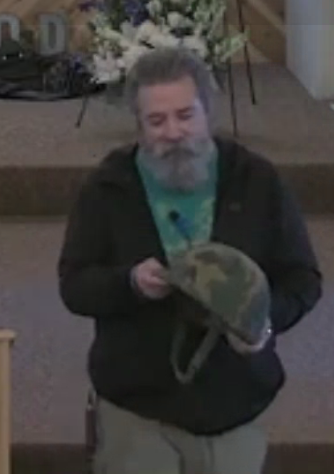
Show-and-tell Sunday, on St. Patrick’s Day. Pastor Rod’s own Marine helmet came first: heavy, steel, with a liner and leather band that were miserable to assemble, padding where a young officer tucked his maps and notes, and a hundred other uses — wash basin, shower, helicopter seat, and (per a congregation member whose cousin helped liberate Manila) a serviceable beer bucket. It would not stop a rifle round, but it stopped flak, and on a modern battlefield you wear one. His son’s Kevlar helmet in Afghanistan did more: three weeks in country, walking to the dining facility, something silver passed just beside his head where a Taliban sniper had the route dialed in.
Then the motorcycle skid lid (DOT-certified, top of the head only), the Roman centurion’s helmet Paul would have seen, and the kippah. Key points from the message:
- The helmet went on last. Put on every other piece, and if your head is unprotected, the rest does not matter.
- Kippah means covering. The word Pastor Rod wrote on it was salvation — and salvation in Hebrew is Yeshua. When God looks down, He should see His salvation on your head.
- Salvation is a one-time event; the hope of salvation is put on every day (1 Thessalonians 5:8). The enemy attacks assurance: “You can’t really be saved — look what you did.”
- The enemy wants us focused on the minute-to-minute; Jesus is in the eternal game (Romans 12:1-2). Renew the mind daily.
- We live under cyber warfare — fake images, fake news, every ad and influence. The helmet protects the mind from the bombardment.
- Adam and Eve wore no helmet and fell to doubt. We wear one now. And He never leaves or forsakes us (Matthew 28:20; Hebrews 13:5).
- John 3:16-18 — even a believing commitment made when you can no longer speak saves. It is not how much faith it takes; it is how little.
- Five points from the bulletin: the helmet protects the head; salvation saves from death; it is a gift; it belongs to God on the throne (Revelation 7:10); and now is the day of salvation (2 Corinthians 6:2).
2. Word Studies
|
Greek: περικεφαλαία (perikephalaia) — “helmet” |
|
Literally “around the head” — peri (around) + kephalē (head). The Greek word describes what the helmet does rather than what it is made of: it surrounds the head. Paul uses it only twice, here and in Notice the verb. For the shield Paul says “take up” (analambanō); for the helmet he says δέξασθε (dechomai) — receive, accept, welcome. It is the word for receiving a gift or a guest. The helmet is not seized; it is received. Compare John 1:12 (“to all who received him”) and Ephesians 2:8-9. |
|
Greek: σωτήριον (sōtērion) — “that which saves” |
|
Paul does not use the common noun for salvation here (sōtēria) but the neuter form sōtērion — “the saving thing,” the means or instrument of salvation. It is the word the Greek Old Testament uses in It is also the word old Simeon used when he held the infant Jesus in the temple: “My eyes have seen your salvation [sōtērion]” (Luke 2:30). He was not describing a doctrine. He was holding a Person. Pastor Rod’s point stands in the Greek: the helmet is not an idea about salvation — it is the One who saves, worn. |
|
Hebrew: יְשׁוּעָה (yeshuah) — “salvation, deliverance, victory” |
|
From the root yasha, “to save, to deliver, to bring into a spacious place.” Yeshuah is rescue that is concrete before it is spiritual — from an army, from death, from the pit. “From the LORD comes deliverance [yeshuah]” ( The name Yeshua (יֵשׁוּעַ) is a form of the same word — “the LORD saves.” That is why the angel said, “you are to give him the name Jesus, because he will save his people from their sins” (Matthew 1:21). Every time the Old Testament says yeshuah, a Hebrew-speaking believer hears His name. Isaiah’s helmet of salvation is, quite literally, the helmet of Yeshua. The kippah. Pastor Rod connected the head covering to salvation and atonement, and the connection is real: the Hebrew word for atonement (kippur, as in Yom Kippur) comes from a root meaning to cover. Jewish tradition wears the kippah as a reminder that God is above. Pastor Rod’s ministry kippah carries the name Yeshua on top — so that when the Lord looks down, He sees His salvation covering the head. That is the helmet. |
3. Historical Background: Four Helmets
The Roman Galea
The helmet on Pastor Rod’s table was a replica of a first-century Roman galea. Made of bronze or iron, it covered the skull, flared into a neck guard at the back, carried hinged cheek pieces that protected the face and jaw while leaving eyes, nose, and mouth clear, and had a reinforcing brow band across the front to stop a downward sword cut. A centurion’s helmet carried a crest — transverse, running ear to ear, so his men could find him in the line. The feathers and plumes Pastor Rod mentioned marked rank and unit.
Paul’s guards wore this. The soldier put it on last because it was the most encumbering piece — hot, heavy, and limiting to hearing — and there was no point wearing it until he was ready to fight. But he did not go into a fight without it. Head wounds were the wounds no one survived.
The Steel Pot
Pastor Rod’s helmet was the M1, the American steel helmet of World War II, Korea, and Vietnam: a steel shell over a separate fiber liner with a suspension band and chin strap. It weighed about three pounds and, as he said, would not reliably stop a rifle round, but it deflected shrapnel and glancing hits — and it served as cooking pot, wash basin, shower, seat, and pillow. The liner could be worn alone. Generations of Marines learned to hate assembling the band and love the helmet.
Kevlar
The PASGT helmet his son wore in Afghanistan replaced steel with layered Kevlar aramid, the same material as the vest — lighter, and capable of stopping fragments and some handgun rounds outright. Modern helmets have improved again. What has not changed since Rome is the principle: whatever else you carry, protect the head first, because the head is where the fight is decided.
The Skid Lid
A DOT-certified half helmet protects the top of the skull and nothing else. It is legal, and it is better than nothing. But Pastor Rod’s honest assessment was that a full-face helmet is what you actually want when you are sliding on asphalt. Half protection is a choice about how much of yourself you are willing to expose. The helmet of salvation is not a skid lid.
4. The Three Tenses of Salvation
Pastor Rod said salvation is a one-time event — and that we put on the hope of salvation every day — and that His salvation is a down payment on a promised resurrection. That is not three different ideas. The New Testament speaks of salvation in three tenses, and the helmet covers all three.
|
|
Saved (past) |
Being saved (present) |
Will be saved (future) |
|
What it is |
Justification — declared righteous, once for all |
Sanctification — the mind renewed, the life transformed |
Glorification — resurrection, new bodies, eternity with Him |
|
Key verses |
|||
|
The enemy’s attack |
“You can’t really be saved” |
“Just this moment matters” |
“There’s no hope; the world is unraveling” |
|
The helmet’s answer |
Assurance: He does things once, and He is eternal |
Renewal: the mind fixed on eternity, not the minute |
Hope: resurrection is guaranteed by His |
|
From the sermon |
Kippah on: salvation is already on your head |
Put Jesus on every single day |
We’ll walk this planet someday in brand-new bodies |
4a. Which tense does your own thinking about salvation live in most — past, present, or future? Which one do you neglect?
5. Guarding the Mind
|
“Do not conform to the pattern of this world, but be transformed by the renewing of your mind. Then you will be able to test and approve what God’s will is—his good, pleasing and perfect will.” |
A helmet guards the head. The helmet of salvation guards the mind — the place where the enemy does his most effective work. Pastor Rod named three assaults.
Doubt of Salvation
“Anybody ever doubted they were saved?” Hands went up. The enemy replays the traffic incident, the tax return, the thing you said, and whispers that a saved person would not have done that. Pastor Rod’s answer: God is eternal and does things one time; we forget, and we have to remind ourselves — and sometimes remind Him, “Lord, I’m Your child.” Scripture is written so that we may know: 1 John 5:11-13; John 10:27-29; Romans 8:38-39. Assurance is not arrogance; it is the helmet staying on.
The Tyranny of the Moment
“Right now, right now, right now — we’re in trouble.” The enemy shrinks the horizon to this hour. Romans 12 is the counter: a mind renewed by God sees the same moment from eternity’s side, where His power is unlimited and His forgiveness is complete. Compare 2 Corinthians 4:16-18 — light and momentary troubles, an eternal glory — and Colossians 3:1-4: set your minds on things above.
Cyber Warfare
Fake images, fake news, every ad, every influence — Pastor Rod said it is no accident the enemy has his own kind of cyber warfare aimed at you. The mind is bombarded, and the bombardment is designed. The helmet is not withdrawal from the world but a mind so renewed it can test and approve what is from God. See Philippians 4:8 (what to think about), 2 Corinthians 10:5 (taking every thought captive), and Psalm 101:3 (what to set before your eyes).
|
The attack on the mind |
What it sounds like |
Helmet response (verse) |
|
Doubt of salvation |
“Look what you did. You can’t be His.” |
|
|
Tyranny of the moment |
“This is all there is, and it’s bad.” |
|
|
Cyber warfare / deception |
“Everyone’s saying it. It must be true.” |
|
|
Hopelessness |
“You’re trapped. The world is unraveling.” |
|
|
Your own (name it): |
|
|
5a. Which of these attacks is loudest in your head this week? What is the specific thought, and what is the specific verse you will answer it with?
6. He Does Not Abandon Us
|
“…And surely I am with you always, to the very end of the age.” |
Pastor Rod pointed to two promises: that Jesus never leaves or forsakes us (Hebrews 13:5-6, echoing Deuteronomy 31:6), and that He is with us to the end of the age. Adam and Eve had no helmet — they did not know there was anything to be saved from — and they fell to the first doubt. We are not in their position. We are clothed in Jesus, covered by His blood, and He does not walk away.
He also pointed to Psalm 16:10 and Peter’s quotation of it at Pentecost, Acts 2:25-32: “you will not abandon me to the realm of the dead, nor will you let your faithful one see decay.” Read carefully, this is David prophesying the resurrection of the Messiah — Peter says so explicitly. That makes it the foundation of Pastor Rod’s point rather than a detour from it. The reason God will not abandon you to death is that He did not abandon Jesus to it. His resurrection is, in Pastor Rod’s words, the down payment on ours (1 Corinthians 15:20-23; 2 Corinthians 1:21-22).
6a. When have you felt abandoned by God? Looking back, what was actually true in that season?
7. Five Things the Helmet Does
Pastor Rod credited Diana with his closing points, printed in the bulletin. Here they are with their scriptures.
1. It protects the head from injury. Ears, face, chin, skull — but it is really Yeshua who does the protecting. “There’s stuff out there that will rip your head clean off.” (Proverbs 3:21-26)
2. Salvation saves us from death. God saves physically — Israel at the sea is the prime example — and He will save the planet. But only One has the cure for death. His salvation is the down payment on resurrection. (John 11:25-26; Romans 6:23)
3. Salvation is a gift of God. You cannot buy it or earn it; people have tried. Ask, and He gives it freely. The only thing you trade is a life you were going to lose anyway for a life that is eternal. (John 3:16-18; Ephesians 2:8-9; Romans 1:16)
4. Salvation belongs to God on the throne. “Salvation belongs to our God, who sits on the throne, and to the Lamb.” We do not usually get gifts from kings. This King gives eternity, liberally. (Revelation 7:9-10; Psalm 3:8)
5. Now is the day of salvation. Yesterday is gone; tomorrow is uncertain; right now is the moment you control. If you do not know Jesus, or want to renew your trust in Him — today is your day. (2 Corinthians 6:1-2; Hebrews 3:15)
|
“For God so loved the world that he gave his one and only Son, that whoever believes in him shall not perish but have eternal life.” |
Pastor Rod admitted he hesitated to preach on the most famous verse in the Bible — the one on the stadium signs — and then could not leave it out. Read all three verses, John 3:16-18. Whoever believes is not condemned. A believing commitment made at the very last, when a person can no longer speak, saves. It is not how much faith it takes; it is how little (Matthew 17:20). That is the helmet: not a wall of doctrine to be mastered, but a Name to be received.
7a. Point 3: the gift is free, but people still ask whether there are strings attached. What has it actually cost you to follow Jesus — and what did you get back?
8. Reflection Questions
1. The helmet went on last. Why do you think Paul places salvation fifth, after truth, righteousness, peace, and faith — and what does that order tell you about how salvation is protected?
2. Pastor Rod’s son was three weeks in country and walking to breakfast when the round passed by. Where are the “ordinary” moments in your week when your head is most exposed?
3. “Salvation in Hebrew is Yeshua.” How does it change your prayer life to say “I put on Jesus” instead of “I remember I’m saved”?
4. A half helmet is legal and better than nothing. Where are you wearing a skid lid — accepting partial protection for your mind because full protection would cost you something?
5. The steel pot could not stop a rifle round; Kevlar could. What in your understanding of salvation has been upgraded over the years — and what are you still trusting to old equipment?
6. Rod said he would gladly trade the life he led before for life in Him. Write two sentences about the trade you made — or the one you are still considering.
9. This Week: Renewing the Mind
The hope of salvation is put on every day. Each morning, write one true thing about your salvation you will carry into the day; each evening, note what tried to knock the helmet off and what you answered with.
|
Day |
Morning: today I put on… |
Evening: what tried to knock it off / my answer |
Verse |
|
Mon |
|
|
|
|
Tue |
|
|
|
|
Wed |
|
|
|
|
Thu |
|
|
|
|
Fri |
|
|
|
|
Sat |
|
|
|
|
Sun |
|
|
|
10. For Further Study
Read these passages during the week. Each one develops a thread from the message.
- Isaiah 59:15-21 — God puts on the helmet of salvation Himself. Paul’s source.
- Isaiah 12:1-6 — “Surely God is my salvation”; the wells of yeshuah.
- Psalm 27 — The LORD is my light and my salvation; whom shall I fear?
- Luke 2:25-32 — Simeon holds salvation in his arms.
- John 10:22-30 — “No one will snatch them out of my hand.”
- Romans 8:28-39 — Nothing can separate us from the love of God.
- Romans 13:11-14 — Salvation nearer now than when we first believed; clothe yourselves with Christ.
- 1 Thessalonians 5:1-11 — Children of the day; the hope of salvation as a helmet.
- Titus 3:3-8 — Saved through the washing of rebirth and renewal by the Holy Spirit.
- 1 John 5:1-13 — Written so that you may know you have eternal life.
Next week: The Sword of the Spirit — Ephesians 6:17b