

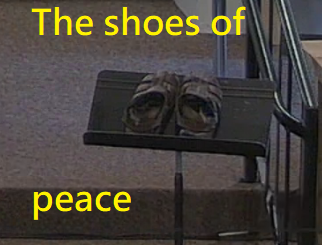

THE ARMOR OF GOD
Week Four • The Shoes of the Gospel of Peace
Feet of Peace
Ephesians 6:15
Beyond the Sermon Workbook
Pastor Rod Meyers • Covington Community Church
All scripture quotations from the New International Version (NIV). Verse references are linked to BibleGateway.
|
“and with your feet fitted with the readiness that comes from the gospel of peace.” |
Pastor Rod opened this message by asking everyone to check their feet. It sounds like a joke, and partly it was — but Paul is serious. The third piece of armor is not a weapon and not a shield. It is what the soldier stands on. A Roman legionary could carry the best sword in the world, but if his feet gave out on the march or slipped on the battlefield, none of it mattered. This workbook goes deeper into the Roman caliga, the Greek and Hebrew words behind “peace” and “readiness,” the surprising biblical pattern of bare feet before God, and the question the sermon ended on: are your feet beautiful?
How to use this workbook: Read each section with your Bible open. Click any reference to read it in full. Write your answers in the space provided — the goal is not to finish quickly but to think clearly.
1. The Sermon in Brief
Before the message, Pastor Rod shared a newspaper report naming the Pacific Northwest the least religious region in the country — roughly two out of three people here have been to church once or twice in their lives, or never. He refused to hear it as bad news. That is room for the gospel. The people we need to reach are all around us.
Then he traded his Sketchers for the sandals he wore in Jerusalem and walked through the piece of armor Paul calls the gospel of peace. Key points from the message:
- Shoes carry memory — cowboy boots, saddle shoes, platform pumps. “Shoes make the man” is a 16th-century saying about wealth on display. But Paul is not talking about fashion.
- The Roman caliga was custom-fitted, hobnailed, and built to cleat into the ground. Soldiers marched 20 miles a day under 60–100 pounds. Their feet had to hold.
- Peace lets us walk a great distance, advance without hesitation, and advance in formation — as a church, not just as individuals.
- The flip side: Moses at the burning bush (Exodus 3:5), the barefoot high priest, and the barefoot hippies of the Jesus Revolution. It is not about shoes. It is about feet shod with peace.
- Shalom is far more than the absence of war — completeness, wholeness, rest, harmony, the fullness of God’s blessing in your lifetime.
- Jesus is Sar Shalom, the Prince of Peace (Isaiah 9:6). His feet were shod with peace even when they were bare. So are ours.
- “How beautiful are the feet of those who bring good news” (Romans 10:15). Are your feet beautiful today?
2. Word Studies
Paul’s Greek in Ephesians 6:15 is dense: “having shod the feet with the readiness of the gospel of peace.” Four words carry the freight — three Greek and one Hebrew underneath them.
|
Greek: ὑποδέω (hypodeō) — “to bind under, to put on footwear” |
|
Hypo (under) + deō (to bind, tie). It pictures lacing a sandal under the foot and binding it on. This is the word Pastor Rod pointed to when he said “shod” means to bind, tie, knit together. Feet shod with peace are feet bound to peace — it goes with you everywhere you walk. Jesus told the Twelve to “wear sandals” (Mark 6:9) when He sent them out, and the angel told Peter to “put on your sandals” before leading him out of prison (Acts 12:8). Both times the word marks the moment before a mission. Sandals on means you are going somewhere. |
|
Greek: ἑτοιμασία (hetoimasia) — “readiness, preparation, firm footing” |
|
This is the word the NIV translates “readiness” and the KJV “preparation.” It appears only here in the New Testament. It comes from hetoimos, “ready, prepared” — the same family as Jesus’ words, “I go to prepare a place for you.” But in the Greek Old Testament the word also means a firm base or foundation — the ground something rests on. The psalmist says of God’s throne that “righteousness and justice are the foundation” (Psalm 89:14). Paul may well have both meanings in view: the gospel of peace is what makes you ready to move and the solid ground you stand on when you do. That is exactly what a hobnailed caliga gave a soldier — footing and mobility at once. Pastor Rod defined preparation as “solid knowledge of something — in this case, knowing the Prince of Peace and His Word.” The apostles could go out with a message of peace because they knew the Word cold. They wore it like a suit of clothes. |
|
Greek: εἰρήνη (eirēnē) — “peace” |
|
From eirō, “to join, to bind together.” Greek peace is the joining of what has been separated — the opposite of a state of war. In the New Testament the word is loaded with the Hebrew meaning of shalom behind it: not merely quiet, but wholeness. Paul uses it eight times in Ephesians. Christ “himself is our peace” who has made one new humanity out of two (Ephesians 2:14-16); He “came and preached peace to you who were far away and peace to those who were near” (Ephesians 2:17); believers are to keep “the unity of the Spirit through the bond of peace” (Ephesians 4:3). The gospel of peace is the message that God is not at war with you — He has made a way to be reconciled (Romans 5:1; 2 Corinthians 5:18-20). |
|
Hebrew: שָׁלוֹם (shalom) — “completeness, wholeness, peace” |
|
Strong’s 7965. From the root shalam, to be complete, whole, sound, to make restitution. Shalom is not the absence of something (war, noise, conflict) but the presence of everything — health, safety, rest, harmony, prosperity, fullness. Pastor Rod’s Messianic rabbi put it this way: may all the blessings of God happen to you in your lifetime, in your space, in your day. The Aaronic blessing ends on it: “the LORD turn his face toward you and give you peace” (Numbers 6:24-26). The Messiah is named for it: Sar Shalom, Prince of Peace (Isaiah 9:6). And His government of peace will have no end (Isaiah 9:7) — a kingdom still to come, which is why we pray for the peace of Jerusalem now (Psalm 122:6). The letters. Shalom is spelled shin – lamed – vav – final mem. Pastor Rod drew on a Jewish teaching tradition that reads meaning in the letter shapes: the vav (ו) resembles a hook or a nail — the letter that joins things together — and points to the One who was nailed to the cross to make our peace. The final mem (ם) is a closed form used only at the end of a word; the tradition reads it as something hidden, a truth sealed and waiting to be revealed. Whatever weight you give to letter symbolism, the theological point stands on its own: the fullness of shalom is hidden in a Person, and He is revealing Himself and His plan of peace to the world. |
3. Historical Background: The Caliga
A Soldier’s Sandal-Boot
The caliga (plural caligae) was the standard footwear of the Roman legionary from the late Republic through the first century. It was a heavy leather sandal-boot: an open-toed upper of laced leather straps, a thick multi-layered sole, and — the feature Pastor Rod highlighted — iron hobnails driven through the sole in patterns. A single caliga could carry dozens of nails. Archaeologists have recovered them from Roman forts across Europe, including the Vindolanda fort on Hadrian’s Wall.
Each pair was made to fit the man. There was no shoe store; a cobbler cut and sewed for the individual soldier, and the cost came out of his pay. The open design let the foot breathe on long marches — no foot powder needed, as Pastor Rod observed — and the nails gave grip on rough ground, the same principle as a modern football cleat.
Built for the March, and for the Line
A legionary on the move carried his weapons, armor, rations, water, entrenching tools, and personal kit — estimates run from 60 to over 100 pounds. Roman roads and Roman feet were the empire’s logistics: a legion could cover twenty miles a day and arrive ready to fight. On the battlefield, the hobnails let the soldier dig in and hold the line when an enemy pushed against the shield wall. They were also a weapon of their own; a kick from a nailed sole was no small thing.
The word left a mark on history. The emperor Gaius was nicknamed Caligula — “little boot” — because as a child he wore a miniature soldier’s caliga around his father’s army camp.
What Paul Saw
Paul spent his imprisonment chained to soldiers of the palace guard (Acts 28:16; Philippians 1:13). He watched them stand, march, and change shifts in these boots. And as a Roman citizen he knew that the legions’ feet had, in a real sense, made the Roman peace — the Pax Romana — possible. Pastor Rod pointed out the irony: Christ conquered the Roman world with a different set of shoes.
4. Four Kinds of Footwear
|
|
Dress shoe |
Roman caliga |
Combat boot |
Gospel of peace |
|
Made for |
Display — “shoes make the man” |
The march and the battle line |
The march, the field, the weather |
The long journey and the spiritual battle |
|
Fit |
Off the shelf |
Custom-made for each soldier |
Sized, broken in with pain |
Fitted to you by the One who wore it first |
|
Grip |
None |
Iron hobnails — cleat in and hold |
Waffle sole |
Firm footing in the Word of God |
|
Endurance |
A few blocks |
20 miles a day, years of service |
Miles, but feet must be cared for |
“Not just for ourselves but for others as well” |
|
Sign of |
Wealth, rank, birth |
Roman military status |
Service |
Belonging to the Prince of Peace |
|
If it fails |
Embarrassment |
Soldier cannot march or hold the line |
Blisters, injury, a man left behind |
Hesitation, fear, no ground to stand on |
5. How We Use This Armor
Pastor Rod drew three practical lessons from how the Roman soldier used his footwear. The gospel of peace does the same three things for the believer.
Walk a Great Distance
Roman feet carried the legion dozens of miles over rough terrain. The Christian journey is long and hard, and God gives us shoes to go the distance. Jesus does not deny the weight of the road — but His yoke is easy and His burden light (Matthew 11:28-30). Peace on your feet protects you from the damage the road would otherwise do. Compare Isaiah 40:31: they will walk and not be faint.
Advance Without Hesitation
Without good footwear, advancing is hard. Without peace, we hesitate — and Pastor Rod said we should, because we have nothing to travel on. But the believer carries a unique message and a unique piece of armor. The peace of God guards our hearts and minds (Philippians 4:6-7). We do not have to hesitate going into a world full of warfare, because we go with what the world does not have (John 14:27).
Advance in Formation
Roman troops moved in formation — to intimidate, and to plow through threats together. Every soldier wore the same footwear; the formation only worked if all the feet held. The church can go one by one with the gospel of peace, but often it goes as a body. “Make every effort to keep the unity of the Spirit through the bond of peace” (Ephesians 4:3). Let “the peace of Christ rule in your hearts, since as members of one body you were called to peace” (Colossians 3:15).
5a. Which of the three is hardest for you right now — going the distance, going without hesitation, or going together? Why?
6. The Flip Side: Barefoot Before God
|
““Do not come any closer,” God said. “Take off your sandals, for the place where you are standing is holy ground.”” |
Pastor Rod flipped the script for the barefoot Pacific Northwest. Paul is not talking about shoes; he is talking about feet. And Scripture has a striking pattern of feet that meet God bare. Moses removes his sandals at the burning bush. Joshua removes his before the commander of the LORD’s army (Joshua 5:13-15). And the high priest — whose garments God prescribed in eight detailed pieces (Exodus 28:1-5, Exodus 28:40-43) — is given no shoes at all. In the tabernacle the priests served barefoot on holy ground.
Pastor Rod’s question: is Jesus wearing shoes today, as our High Priest before Almighty God, interceding for us? He may be barefoot. But His feet are shod with the gospel of His peace.
The point cuts two ways. When we come before God there is nothing between Him and us; we stand on His ground with nothing of our own. And when we go out from Him, what is on our feet is not leather but peace. The Jesus Revolution converts who spoiled the church carpets with bare feet were wearing the only footwear that mattered.
6a. Where in your life do you need to “take off your sandals” — to stop standing on your own footing and stand on holy ground?
7. Beautiful Feet
|
“How beautiful on the mountains are the feet of those who bring good news, who proclaim peace, who bring good tidings, who proclaim salvation, who say to Zion, “Your God reigns!”” |
Paul quotes this verse in Romans 10:15 to answer his own chain of questions: how can they call on Him unless they believe, believe unless they hear, hear unless someone preaches, preach unless they are sent? The answer is feet. Somebody has to walk the message to the people who have not heard it. Nahum saw the same picture — feet on the mountains bringing good news and proclaiming peace (Nahum 1:15).
Notice what the feet in Isaiah are doing. They proclaim peace, bring good tidings, proclaim salvation, and announce that God reigns. That is the gospel of the kingdom in one verse — and Pastor Rod said that is our business, our politics, and our piece of the pie.
Jesus sent the seventy-two out with exactly this footwear: the first word into every house was to be “Peace to this house” (Luke 10:5-6). Zechariah prophesied that the Messiah would “guide our feet into the path of peace” (Luke 1:79).
Room for the Gospel
Two out of three people in this region have little or no experience of church. Pastor Rod wondered aloud what would happen to those numbers if we took a gospel of peace to our communities — and observed how, when you meet a person of peace, your defenses come down automatically. The opportunity here is almost unlimited. The seat next to you is empty for a reason.
7a. Name one person in your life who has never heard the gospel, or has not heard it in years. What would it look like to carry peace to them this month?
7b. When people encounter you, do their defenses come down? What in you makes peace visible — or hides it?
8. Reflection Questions
1. Paul places the shoes third, after truth and righteousness. Why might readiness to carry the gospel depend on those two pieces being in place first?
2. Pastor Rod said the gospel is the message that God is not angry with human beings but wants to make peace with them. Is that the version of the gospel you carry? What version do you think most people around you assume Christians carry?
3. Shalom means completeness and wholeness, not just quiet. Where are you settling for the absence of conflict when God is offering wholeness?
4. The caliga was custom-fitted. How has God fitted the gospel of peace specifically to you — your story, your temperament, the people you naturally reach?
5. Read Isaiah 26:3. What does it mean, practically, for your mind to be “steadfast” on God this week? What competes for that steadiness?
6. The world will not be at peace until the Peacemaker comes — but you are a piece of that peace. How do you hold both truths without either despair or naïveté?
9. This Week: Walk It Out
Pastor Rod said peace has to be walked out every single day. Use this table each evening to record where your feet went and what they carried.
|
Day |
Where I walked / who I met |
Did I carry peace? What happened? |
Verse I stood on |
|
Mon |
|
|
|
|
Tue |
|
|
|
|
Wed |
|
|
|
|
Thu |
|
|
|
|
Fri |
|
|
|
|
Sat |
|
|
|
|
Sun |
|
|
|
10. For Further Study
Read these passages during the week. Each one develops a thread from the message.
- Isaiah 9:1-7 — The Prince of Peace and the government that will have no end.
- Isaiah 52:7-10 — Beautiful feet on the mountains; the LORD bares His arm before the nations.
- Isaiah 59:15-21 — God puts on His own armor. Paul’s source for Ephesians 6.
- Ephesians 2:11-22 — Christ is our peace; He preached peace to the far and the near.
- Romans 10:9-17 — Faith comes by hearing, and hearing needs someone sent.
- 2 Corinthians 5:14-21 — The ministry and message of reconciliation, entrusted to us as ambassadors.
- Luke 10:1-12 — The seventy-two sent with “Peace to this house.”
- Philippians 4:4-9 — The peace of God that transcends understanding; the God of peace with you.
- Psalm 122 — Pray for the peace of Jerusalem.
- Micah 5:2-5 — The ruler from Bethlehem: “And he will be our peace.”
Next week: The Shield of Faith — Ephesians 6:16