


BEYOND THE SERMON
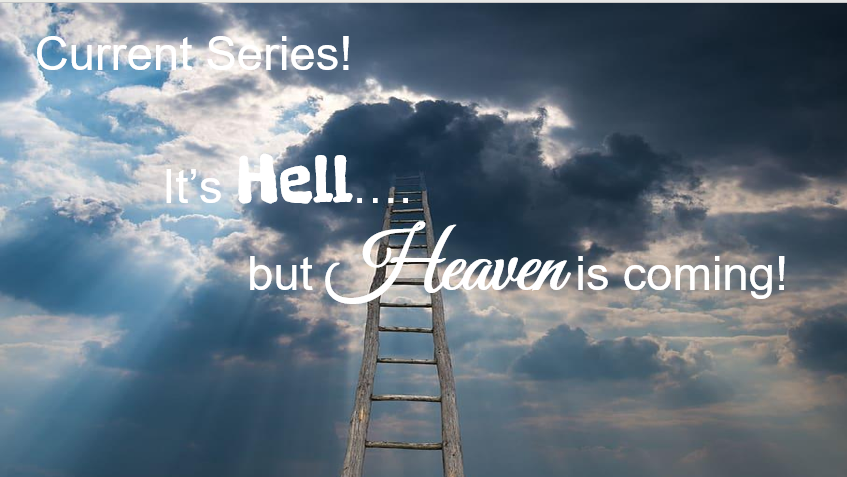
It's Hell, But Heaven's Coming
Message 5: The Doorway to Heaven — The Divine Bridge
Pastor Rod Meyers • Covington Community Church • Key texts: Genesis 28:12; John 1:51 (NIV)
Message Overview
Everyone has misplaced their keys — run through the house, checked every pocket — only to find them in your hand or exactly where you left them. Heaven can be like that: closer than you think, maybe right in your hand. Jacob was not looking for heaven the night he lay down in the wilderness. He was running — from his brother, from his guilt, maybe from himself. Anyone who has run from the Lord and run smack into Him knows the feeling. Sometimes the very thing you are running from is the thing you run into.
Heaven does not wait for you in the perfect location. Sometimes it meets you right where you are, with a rock for a pillow. This message follows the stairway from Jacob's dream at Bethel to Jesus' words to Nathanael, from a vision to a Person, and from one holy mountain in Jerusalem to a bridge that reaches wherever you are.
Key Scripture
|
He had a dream in which he saw a stairway resting on the earth, with its top reaching to heaven, and the angels of God were ascending and descending on it. |
|
He then added, "Very truly I tell you, you will see 'heaven open, and the angels of God ascending and descending on' the Son of Man." |
Word Study
|
Stairway, Place, and House Sullam (סֻלָּם) — "stairway" or "ladder" Used only here in the Old Testament (Genesis 28:12). Older translations say "ladder"; the picture is closer to a stairway or ramp — and it functions as a doorway or portal connecting heaven and earth. The stairway was not a structure Jacob built or designed. It was something God revealed, in the thick of a life whose attention was somewhere else entirely. HaMakom (הַמָּקוֹם) — "the place" Genesis 28 keeps repeating "the place" (Genesis 28:11, Genesis 28:16-17). In later Jewish usage HaMakom became a name for God Himself — the One who is the place. Jacob marks it as the spot where heaven touches earth, and future generations would remember it as holy ground. Beit-El (בֵּית־אֵל) — "house of God" Jacob anoints the stone he slept on and renames the place Bethel (Genesis 28:18-19). The city was formerly called Luz. Bethel is not just ancient poetry; it is an invitation. Whether you are in your home or your car, if your heart is weary you can come to Bethel — because Jesus is the house. "On the Son of Man" (Greek: ἐπὶ τὸν υἱὸν τοῦ ἀνθρώπου) In John 1:51 Jesus quotes Jacob's dream almost word for word — but where Genesis says the angels ascended and descended "on it" (the stairway), Jesus says "on the Son of Man." He does not say on a ladder. He says on Me. Jacob's ladder was symbolic; Jesus is the substance. |
Jacob's Dream: The Original Stairway to Heaven
Genesis is full of dreams — Joseph's, Pharaoh's — but Jacob's is one of the most vivid in the Old Testament. On the run from Esau, alone in a barren place, he sees a stairway with angels moving up and down it, and the LORD standing above it renewing the promise made to Abraham (Genesis 28:13-15). To Jacob it was more than a dream; it was a revelation. He woke and said, "Surely the LORD is in this place, and I was not aware of it" (Genesis 28:16).
Have you ever walked onto a piece of ground and sensed something holy you did not expect? Pastor Rod tells of driving past this church with his mother sixteen-plus years ago and feeling it, and of an unexplained moment of déjà vu on a Dallas street before realizing he was standing at the site of the Kennedy assassination. Sometimes you have to be in a place to recognize what happened there — and that happens with God all the time.
Three insights from Jacob's vision
- The stairway was not something Jacob built. It was something God revealed — while Jacob was paying attention to other things.
- The angels remind us of ongoing traffic between heaven and earth. God is not distant; He is actively engaged and always plugged in. We do not always perceive it, but just because we do not see it does not mean it is not happening (Hebrews 1:14; Psalm 34:7).
- The stone Jacob used as a pillow became a memorial. He anointed it and called the place Bethel — the house of God, the gate of heaven. Sometimes we have to be uncomfortable to find what we are looking for. You will not find a rock pillow at Motel 6, but you may not find a divine dream there either.
From the Ladder to the Lord
Fast-forward to the New Testament. Jesus tells Nathanael he will see heaven open and the angels of God ascending and descending on the Son of Man (John 1:47-51). Jesus is the way and the connection. What was disconnected by Adam in the garden was reconnected by the second Adam (Romans 5:18-19; 1 Corinthians 15:45-47). Jacob saw a dream; Jesus is the dream fulfilled.
In other words: Jacob saw a vision, but John saw a Person. In the film Romancing the Stone the treasure hunters discover that what they were really searching for was not a stone but a person. The thing we are looking for is not stone either. Jesus is the living bridge — the divine connector between heaven and earth, between God and humanity, between eternity and everyday life. That is what the temple did in its day; it is what Jesus does forever (1 Timothy 2:5).
|
|
Jacob at Bethel |
Jesus, the Son of Man |
|
What was seen |
A vision in a dream (Genesis 28:12) |
A Person standing in front of Nathanael (John 1:51) |
|
The connection |
A stairway — symbolic |
Jesus Himself — substance (John 14:6) |
|
Who built it |
Not Jacob; God revealed it |
Not us; God provided it (Ephesians 2:8-9) |
|
The house of God |
A stone pillar at Bethel (Genesis 28:18-22) |
"Destroy this temple and I will raise it again in three days" (John 2:19-21) |
|
Where it stands |
One place in the wilderness |
Everywhere Jesus is — the whole planet (Matthew 18:20; Matthew 28:20) |
Jerusalem: A Physical Bridge
Zoom out geographically and Jerusalem stands as a historical bridge between heaven and earth. Long before anything was built there, Abraham met Melchizedek, king of Salem — a prototype of an eternal priesthood (Genesis 14:18-20; Hebrews 7:1-3). The tabernacle came, then at least two temples built by Jacob's descendants, where sacrifices ascended like prayers (2 Chronicles 3:1). And it is where Jesus Himself was crucified and resurrected.
On his recent trip, Pastor Rod came back from Hebron in the West Bank with no place to stay. A Muslim friend arranged a room at the Jerusalem Hotel across from the central bus station — tires squealing in the parking lot, thoroughly modern. Then he checked the map: 400 feet from the site of the crucifixion, two floors up. He slept above the place where the most pivotal point in the cosmos took place, where life began again and everything became new.
The Temple Mount is believed to be the spot where heaven and earth touch; even today Jewish prayer is directed toward Jerusalem, "straight up to God's ear." But we know that anywhere and anytime we pray — with two or three, or alone — the Lord is listening (John 4:21-24). In Christ, the sacred geography expands from one mountain to the entire planet. Jerusalem is not just a place of stone but a place of flesh: Jesus gave up His flesh there so we could be saved, and He is building living relationships in Himself (1 Peter 2:4-5).
What about a third temple?
Talk of rebuilding the temple is live in Israel today, and when the politics settle there will probably be a third temple. But it will in no way take the place of Jesus. The forgiveness, the resurrection, the divinity — it is all in Him. No building will bring that into existence (Hebrews 9:11-12; Hebrews 10:19-22).
Jesus: The Spiritual Bridge
|
Jesus answered, "I am the way and the truth and the life. No one comes to the Father except through me." |
In Jesus, heaven is not a faraway realm; it is a present reality. Through His incarnation, sacrifice, and resurrection, Jesus does not just show the way — He becomes the way. Every prayer, every act of forgiveness, every moment of worship is a step on the divine bridge that connects us to the Father.
|
For God was pleased to have all his fullness dwell in him, and through him to reconcile to himself all things, whether things on earth or things in heaven, by making peace through his blood, shed on the cross. |
Jesus is the point of all reality. Everything comes together in Him.
Finding Heaven's Door in Everyday Life
So often we are waiting for someone to open the door — but maybe, like Jacob, the door is right in front of us. It is an everyday thing.
- When you forgive someone who hurt you, you have opened heaven's door a little wider. It is a tough one — "Father, forgive them, for they do not know what they are doing" (Luke 23:34) — but forgiveness opens the door (Matthew 6:14-15).
- When you love your neighbor or comfort a child, you are standing on the bridge, in heaven's doorway (Matthew 25:40).
- When you worship through pain, you are walking the same path the angels ascended and descended on.
"If there is a God, why human suffering?"
A Jewish atheist in the peace movement — one of the people who brought Pastor Rod into Hebron — asked that question. The short answer: God suffered for us. He understands human suffering, He knows your pain, and He has a remedy for it (Isaiah 53:3-5; Hebrews 4:15-16). Suffering is the one thing every human has in common; why wouldn't God share it? He does. When we reach out in pain we open heaven's door a little wider and stand in recognition with Jesus Christ.
Stepping onto the Bridge
|
He was afraid and said, "How awesome is this place! This is none other than the house of God; this is the gate of heaven." |
- Heaven's doorway is open because it is a Person, and His heart is open to you. Jesus died in Jerusalem and opened the door; the temple veil — as thick as a man's hand and stories high — was torn from top to bottom (Matthew 27:51). God accomplishes even what seems impossible.
- The bridge has already been built, and it was built for you to cross. Hell is a prison; heaven was built for you. You were created for eternity.
- Heaven is not just a place, and the bridge to heaven is not just a place. It is a Person named Jesus Christ, and every reward comes with Him (Revelation 22:12).
- If you are looking for heaven, start praying — you know who has the key (Revelation 3:7-8). When you feel lost, remember Jacob's dream. When you feel disconnected, remember John's gospel. The same God who met Jacob in the wilderness will meet you through the grace of Christ.
Maybe you have been standing at the edge of faith, looking for a sign from heaven. Know that it is closer than you think. Jesus is closer than you think.
Reflection Questions
1. Jacob was running from his brother, his guilt, and himself when God met him. Have you ever run from God and run straight into Him? What were you running from, and where did He find you?
2. Read Genesis 28:10-17. "Surely the LORD is in this place, and I was not aware of it." Where has God been present in your life recently that you only recognized afterward?
3. Jacob's stairway was revealed, not built. Where are you still trying to build your own way to God — through effort, performance, or the perfect circumstances — instead of receiving the bridge He provided?
4. Read John 1:47-51. Jesus says the angels ascend and descend "on the Son of Man" — on Him, not a ladder. What is the difference, for you personally, between believing heaven is a place and believing the way to it is a Person?
5. Forgiveness, loving a neighbor, worshiping through pain: "each one opens heaven's door a little wider." Which of the three is hardest for you right now? Who or what is involved?
6. How would you answer the atheist's question — "If there is a God, why human suffering?" Read Isaiah 53:3-5 and Hebrews 4:15-16. Does "God suffered for us" satisfy you? Why or why not?
Further Study
- Genesis 28:10-22 — the full account of Bethel, including Jacob's vow.
- Genesis 35:1-15 — Jacob returns to Bethel and God confirms the name Israel.
- Genesis 14:17-20 and Hebrews 7:1-28 — Melchizedek, king of Salem, and the eternal priesthood of Jesus.
- John 1:43-51 — Nathanael under the fig tree and Jesus' promise of an open heaven.
- John 14:1-11 — "I am the way": the Father's house and the Father seen in the Son.
- Hebrews 10:19-25 — a new and living way opened through the curtain, that is, His body.
- Colossians 1:15-23 — reconciling all things in heaven and on earth through the cross.
- Revelation 21:22-27 — the city with no temple, because the Lord God Almighty and the Lamb are its temple.