



THE ARMOR OF GOD
Week Seven • Series Finale • Palm Sunday
The Sword of the Spirit
Ephesians 6:17b–18
Beyond the Sermon Workbook
Pastor Rod Meyers • Covington Community Church
All scripture quotations from the New International Version (NIV). Verse references are linked to BibleGateway.
|
“Take the helmet of salvation and the sword of the Spirit, which is the word of God. And pray in the Spirit on all occasions with all kinds of prayers and requests. With this in mind, be alert and always keep on praying for all the Lord’s people.” |
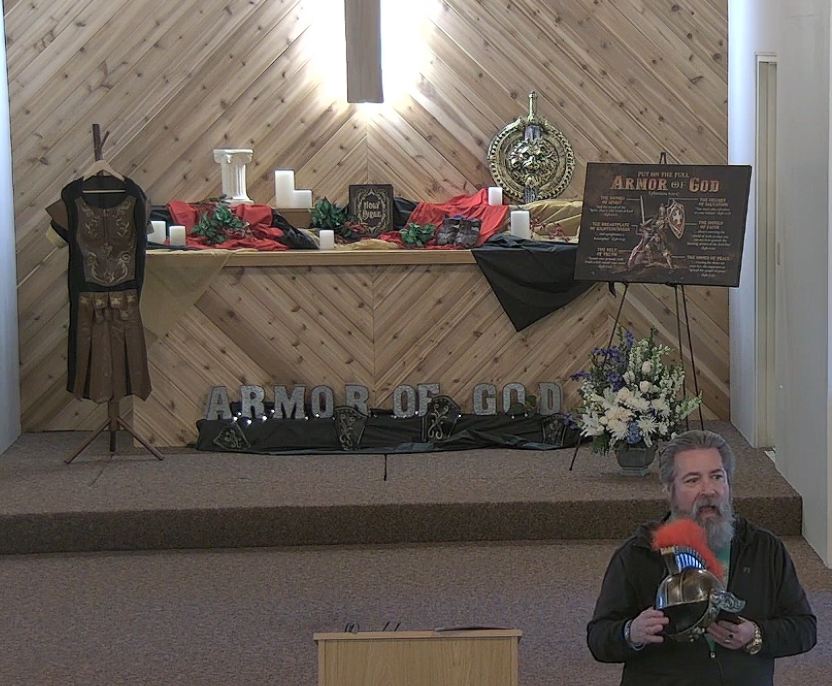
Six pieces of armor are defensive. The seventh is not. Pastor Rod closed the series on Palm Sunday with a sword from his own collection — a double-edged, pointed blade of the kind a Roman soldier worked from behind his shield — and made the claim the whole series has been building toward: the only offensive weapon a believer is issued is the Word of God, and the Word of God is Jesus Himself. This workbook takes the sword apart: the Greek behind “sword” and “word,” the Roman gladius and the daily drill that kept a soldier alive, the difference between using the Word and misusing it, what verse 18 says you actually do with the sword, and a review of the full armor now that every piece is on.
How to use this workbook: Read each section with your Bible open. Click any reference to read it in full. Write your answers in the space provided — the goal is not to finish quickly but to think clearly.
1. The Sermon in Brief
When Jesus rode into Jerusalem and the whole city asked who He was, the crowd answered: “This is Jesus, the prophet from Nazareth in Galilee” (Matthew 21:10-11). Pastor Rod started there. A prophet speaks the word of God — and the last piece of armor is the word of God. Key points from the message:
- The sword Paul names is the short, double-edged, pointed blade for close combat, worked from behind the big shield. Growing up, any stick in the yard would do. The real thing is the Word — Jesus’ own words, thoughts, and intent.
- It is the only offensive weapon authorized for our use. Without it we have nothing to advance with.
- Offense: the gospel. Some people are offended by it, and some Christians beat people up with the Bible. Use it the way it was intended.
- Eisegesis is reading your own opinion into the text and getting preachy. Exegesis is drawing out what God actually put there. Don’t be that person; study.
- Roman swordsmen practiced every day to stay alive. Jesus’ disciples study the Word for the same reason — Matthew 4 is the model (Matthew 4:1-11).
- The Word cleaves between bone and marrow, spirit and flesh (Hebrews 4:12). It is a surgeon’s scalpel more than a soldier’s blade — meant to help, not to hurt.
- Defense: apologetics. The Word defends the faith and defends your people.
- Verse 18 is what you do with the sword: pray in the Spirit on all occasions, for all the Lord’s people. Not to show off — to do God’s work.
- The bracelet holds all six pieces. God did not leave us naked, without His word, or defenseless when He went to prepare a place for us. Put it on daily, and you have put on Jesus.
- The series ends, but the sword goes to Nigeria — and into Passion Week.
2. Word Studies
|
Greek: μάχαιρα (machaira) — “short sword, dagger” |
|
Paul did not choose rhomphaia, the great two-handed Thracian sword that appears in Revelation as the sword from Christ’s mouth ( This is the sword of Hebrews 4:12 (“sharper than any double-edged machaira”) and the sword Jesus meant when He said He came to bring not peace but a sword (Matthew 10:34) — a blade that divides at close range. The believer’s offensive weapon is personal, precise, and near. |
|
Greek: ῥῆμα (rhēma) — “spoken word, utterance” |
|
Greek has two words for “word.” Logos is the word as message, reason, the whole revealed truth — the Word who was with God and was God ( That fits Pastor Rod’s point exactly. The sword is not the Bible on the shelf; it is the specific word spoken into the specific moment. When Jesus answered the tempter, He did not cite the Torah in general — He spoke three particular verses (Matthew 4:4, Matthew 4:7, Matthew 4:10). “Man shall not live on bread alone, but on every word [rhēma] that comes from the mouth of God.” The sword is the Word in your mouth. Compare Romans 10:17 (faith comes from hearing the rhēma of Christ) and John 6:63 (“the words [rhēmata] I have spoken to you — they are full of the Spirit and life”). The sword is of the Spirit because the Spirit is the one who brings the right word to mind at the right time (John 14:26). |
|
Hebrew: דָּבָר (davar) — “word, matter, thing” |
|
The Hebrew word for “word” also means “thing” or “event.” In Hebrew thought a word from God is not a description of reality; it is reality being made. “By the word of the LORD the heavens were made” ( Isaiah saw the Servant’s mouth made “like a sharpened sword” (Isaiah 49:2) — the Messiah’s word is His weapon. When the prophet of Nazareth spoke, He was wielding the davar of the LORD. That is why a prophet and a sword belong in the same sermon. |
3. Historical Background: The Gladius and the Drill
The Sword
The gladius of Paul’s day was around two feet long, double-edged, with a long tapering point. It was designed for thrusting rather than slashing: the legionary held it in his right hand, low, and stabbed from behind the cover of the scutum on his left. A thrust of a few inches into the torso ended the fight. The blade was worn on the right hip — unusual for a sword — so it could be drawn without fouling the shield. Pastor Rod’s replica, like his display sword, could be called either a sword or a long dagger. The Romans made the same distinction loosely; what mattered was that it was short, sharp, and close.
The Drill
Roman recruits trained at a wooden post with a wooden sword and wicker shield, each made deliberately twice the weight of the real thing, so that the actual weapons felt light. They drilled twice a day, morning and afternoon. Gladiators trained the same way and, as Pastor Rod said, practiced daily because their lives depended on it. The Roman military writer Vegetius said the legions conquered the world by nothing more than the drill — constant, repetitive practice until the movements were reflexes. There was no such thing as a legionary who knew about the sword but had not handled it that week.
What Paul Wanted the Ephesians to See
Paul spent his imprisonment chained to men who carried this sword (Acts 28:16). He would have watched them clean it, sharpen it, and drill with it. He tells Timothy the same thing in different language: be a worker who correctly handles the word of truth (2 Timothy 2:15) — the Greek says “cuts it straight.” The sword of the Spirit is not just possessed; it is handled, and handled well.
4. Wielding It Rightly
Pastor Rod was as clear about how not to use the sword as about how to use it. The same blade that heals can maim. Here is the distinction he drew:
|
|
Misuse |
Right use |
Scripture |
|
Interpretation |
Eisegesis — reading your opinion into the text; “that’s our matter we bring onto people” |
Exegesis — drawing out what God put there; studying, and studying with others |
|
|
Offense |
Beating people up with the Bible; being “that preachy person” |
The gospel, used as intended — a surgeon’s scalpel that cuts to heal |
|
|
Defense |
Winning arguments; defending yourself |
Apologetics — defending the faith and your people, with gentleness and respect |
|
|
Motive |
To show off; to be showy |
To pray, to strengthen, to do God’s work |
|
|
Source |
Your intent |
His intent — “His words, His thoughts, His intent” |
Exegesis in Practice
Try it on the sermon’s own key verse. Read Ephesians 6:17-18 and answer from the text alone: What does Paul say the sword is? Who does it belong to (“of the Spirit”)? What is the very next instruction after “take” it? What word is repeated four times in verse 18?
4a. Where have you seen the Word misused — on you, or by you? What did it cost?
5. The Sword in the Master’s Hand
|
“For the word of God is alive and active. Sharper than any double-edged sword, it penetrates even to dividing soul and spirit, joints and marrow; it judges the thoughts and attitudes of the heart.” |
Pastor Rod said the sword is crafted by Jesus and wielded by His disciple. Watch the Craftsman use it first. In the wilderness (Matthew 4:1-11), three darts came in and three verses went out — all from Deuteronomy, all memorized, all spoken aloud. The devil quoted Scripture too (Matthew 4:6); Jesus answered misused Scripture with rightly handled Scripture. That is exegesis under fire. After the third parry He said, “Away from me, Satan!” and the devil left. The sword ends fights.
Then watch Him use it to heal. The same Word that drove the devil off drew the crowds in. He taught with authority (Matthew 7:28-29), and the Samaritans said, “we have heard for ourselves” (John 4:41-42). Hebrews calls the sword alive and active — it judges thoughts and attitudes. A surgeon’s scalpel does not attack the patient; it cuts precisely to remove what is killing him. Pastor Rod: the Word cleaves between bone and marrow, spirit and flesh — and only His Word can do that.
And on Palm Sunday, watch the crowd name Him: the prophet. A prophet speaks the word of God. The Word made flesh (John 1:14) rode into the city that would kill Him, with His eye — as Pastor Rod said — on you. The sword of the Spirit is, in the end, the One who spoke it.
5a. Name a time the Word cut you — exposed a thought or attitude you had not seen. What did the cut remove, and what healed?
6. What You Do With the Sword: Verse 18
Pastor Rod stopped on the verse after the sword and said: that is what we do with this weapon. Paul does not describe fighting with the sword; he describes praying. Notice the four “alls”:
- All occasions. Not only in crisis. The soldier who drills daily is the one whose sword is ready in the ambush (1 Thessalonians 5:17).
- All kinds of prayers and requests. Praise, confession, thanksgiving, intercession, petition — the whole arsenal (Philippians 4:6).
- Always keep on praying. Alertness and persistence — the watchman’s posture (Colossians 4:2; Luke 18:1).
- All the Lord’s people. The sword is drawn for others. Paul asks in the next verse that they pray for him — that words may be given him to declare the gospel fearlessly (Ephesians 6:19-20).
Praying “in the Spirit” and the sword “of the Spirit” belong together: the same Spirit who brings the Word to mind carries the prayer to the Father. Pastor Rod testified that this congregation has prayed a great deal and seen God respond in a mighty way. Word and prayer are the sword’s two edges.
6a. Which of the four “alls” is weakest in your prayer life? Write one specific change for this week.
7. The Full Armor: Series Review
Pastor Rod held up the bracelet and read off every piece. God did not leave us naked. Here is the whole arsenal in one place, with the thread of each message.
|
Piece |
Verse |
What it is |
The message in a line |
|
Belt of truth |
God’s truth, buckled on daily; everything else hangs on it |
Buckle up. A half-truth is still a lie. |
|
|
Breastplate of righteousness |
Christ’s righteousness given, then practiced; guards the heart |
Right isn’t righteous. Only His metal stops the blade. |
|
|
Shoes of the gospel of peace |
Readiness and firm footing to carry peace a long way |
Are your feet beautiful? Even bare, they’re shod. |
|
|
Shield of faith |
Believing God; door-sized, water-soaked, locked with others’ shields |
Faith is believing. Be a battle tank. |
|
|
Helmet of salvation |
Salvation received, hope worn daily; guards the mind |
Salvation in Hebrew is Yeshua. Put on Jesus. |
|
|
Sword of the Spirit |
The Word of God, spoken; the one offensive weapon |
Handle it rightly. It is Jesus Himself. |
|
|
Prayer |
How the whole armor is worn and the sword is wielded |
All occasions, all kinds, always, all the Lord’s people. |
Three things true of every piece: each is a gift, free to you; each is God’s own armor, worn by Him first (Isaiah 59:17); and each must be put on daily — your salvation is guaranteed once, but the armor goes on every morning. Pastor Rod’s summary: by yourself you are a weakling; in His armor you are no weakling, and you have put on Jesus for everyone to see. Some will love you, some will not understand you — but those who receive you receive the King (Matthew 10:40).
7a. Which piece of the armor have you most neglected over these seven weeks? Which one has changed how you live? Be specific.
8. Reflection Questions
1. The sword is the only offensive weapon in the list. What does that tell you about how the Christian is meant to advance — and what we are not meant to advance with?
2. Roman recruits trained with weapons twice the weight of the real thing so the real ones felt light. What would “heavy training” with the Word look like for you — something harder than your current habit, so that the ordinary use feels easy?
3. Pastor Rod said people will need the Word “through your lens, your set of goggles.” Who has God positioned you — and only you — to speak the Word to?
4. The sword is a surgeon’s scalpel. When you last shared Scripture with someone in a hard moment, was it a scalpel or a club? How could you tell?
5. The crowd celebrated Jesus for the wrong reasons on Sunday and hated Him for the wrong reasons on Friday. How does the Word keep you steady when praise and hostility both come for the wrong reasons?
6. Pastor Rod said the series isn’t over — the sword goes to Nigeria. Where does your sword go this week? Name the place, the person, and the verse.
9. This Week: Sword Drill
Jesus answered the tempter from memory. This week, memorize one verse a day — spoken aloud, morning and evening, the way a recruit drilled at the post. Suggested verses are given; substitute your own.
|
Day |
Verse to memorize |
Where I spoke it / used it today |
Done |
|
Mon |
|
|
|
|
Tue |
|
|
|
|
Wed |
|
|
|
|
Thu |
|
|
|
|
Fri |
|
|
|
|
Sat |
|
|
|
|
Sun |
|
|
10. For Further Study
Read these passages during Passion Week. Each one develops a thread from the message.
- Matthew 21:1-17 — Palm Sunday: the prophet from Nazareth enters the city.
- Isaiah 49:1-7 — The Servant’s mouth like a sharpened sword.
- Isaiah 55:6-13 — The word that does not return empty.
- Psalm 119:9-16 — The Word hidden in the heart.
- Deuteronomy 6:4-9 — The Word on the heart, the hand, and the doorframe — the source of Jesus’ wilderness answers.
- Hebrews 4:12-16 — The living Word, and the great High Priest.
- 2 Timothy 3:14-4:5 — All Scripture God-breathed; preach the Word in season and out.
- 1 Peter 3:13-17 — Always prepared to give an answer, with gentleness and respect.
- Revelation 19:11-16 — The Word of God rides out, with a sword from His mouth.
- Ephesians 6:10-20 — The whole armor, read in one sitting, now that every piece is on.
This concludes The Armor of God. Next Sunday: Resurrection Sunday.