


THE ARMOR OF GOD
Week Three
The Breastplate of Righteousness
Ephesians 6:14b
Beyond the Sermon Workbook
Pastor Rod Meyers • Covington Community Church
All scripture quotations from the New International Version (NIV). Verse references are linked to BibleGateway.
|
“Stand firm then, with the belt of truth buckled around your waist, with the breastplate of righteousness in place,” |
Last week the belt. This week the piece that hangs from it and covers the heart. Pastor Rod built the message on a distinction most of us blur: being right and being righteous are not the same thing. You can be right and still be lost. You cannot be righteous on your own at all — Scripture says there is no one righteous, not even one. So where does the breastplate come from, and what does it mean to put on something you cannot make? This workbook works through the Greek and Hebrew words, the Roman lorica segmentata and its modern Kevlar descendant, the two ways the Bible speaks of righteousness, and the practical question of guarding the heart every day.
How to use this workbook: Read each section with your Bible open. Click any reference to read it in full. Write your answers in the space provided — the goal is not to finish quickly but to think clearly.
1. The Sermon in Brief
The service opened with a gift — a red-letter Bible more than a hundred years old, now at home in the congregation — read aloud from Matthew 4:4: man does not live on bread alone, but on every word that comes from the mouth of God. Pastor Rod noted that this is the sword of the Spirit, the offensive weapon, still to come in the series.
Then a story from his first year as a teacher at Cookson Hills. On the wall of the teachers’ lounge — a room he had rarely seen as a student, having spent more time in the principal’s office — hung a maxim: What is right is not always popular, and what is popular is not always right. The source turned out to be Albert Einstein, who fled Nazi Germany at the height of the most popular movement of the century. He had earned the right to say it. Key points from the message:
- Rightness is a logical concept — your answer is correct. Righteousness is a religious concept — right standing with God, judged innocent. A clock is right twice a day; only one Person has ever been righteous.
- “There is no one righteous, not even one” (Romans 3:10). Righteousness cannot be manufactured, purchased, or borrowed from another believer. It comes from Christ alone, as a gift.
- The Greek word for breastplate is thōrax — literally the chest, the heart-protector. Isaiah saw God wearing it first (Isaiah 59:17); Paul mentions the armor of righteousness elsewhere too (2 Corinthians 6:7).
- The Roman lorica segmentata was flexible, segmented, and polished — it moved with the soldier and blinded the enemy with reflected light. Christ’s reflection in us is formidable (Malachi 4:2).
- Our righteousness is filthy rags (Isaiah 64:6). It will not stand up against an enemy who is faster, sharper, and meaner than we are. We need stronger metal.
- Putting it on daily: submit to God and resist the devil (James 4:7); cut off what triggers you (Matthew 5:30); hunger and thirst for it (Matthew 5:6); seek it first (Matthew 6:33).
- Old friends may disappear when you put on the armor. That is often a mercy — and God sends new ones.
- A Marine’s testimony: watching an M16 round fail to pierce a Kevlar vest on a training film, and going into combat with a layer of protection he did not know he had. His righteousness is like that — but it only protects you if you wear it.
2. Word Studies
|
Greek: θώραξ (thōrax) — “breastplate, chest” |
|
Thōrax is both the body part and the armor that covers it — the chest cavity that holds the heart and lungs, and the plate that guards them. Anyone who has had thoracic surgery has met a surgeon working on exactly this territory. Paul uses the word for the armor here and in the only other New Testament passage where he lists armor pieces: “putting on faith and love as a breastplate” ( Notice what the breastplate does not cover: the back. Roman armor assumed the soldier faced the enemy. There is no provision in Ephesians 6 for retreat — the armor protects a believer who stands (Ephesians 6:13). |
|
Greek: δικαιοσύνη (dikaiosynē) — “righteousness, justice” |
|
From dikē, “justice, what is right” — the word Athenian courts used for a verdict. Dikaiosynē is the state of being in the right before a judge. Pastor Rod’s definition of right standing is the courtroom meaning: when you are judged and found innocent, you are in the right. The New Testament uses the word in two connected ways. First, a standing God gives — “the righteousness of God” credited to the believer by faith (Romans 3:21-22; Philippians 3:9). Second, a way of living that flows from that standing — “whoever does what is right is righteous” (1 John 3:7). Paul has both in mind. The breastplate is Christ’s righteousness given to you, and it is put on every day by practicing it. |
|
Greek: ἐνδύω (endyō) — “to put on, to clothe oneself” |
|
The verb behind “put on the full armor” (Ephesians 6:11) and “put on the new self, created to be like God in true righteousness and holiness” (Ephesians 4:24). It is the ordinary word for getting dressed. Paul’s most striking use is Romans 13:14: “clothe yourselves with the Lord Jesus Christ.” The breastplate of righteousness is not an abstraction; it is Christ Himself, worn. |
|
Hebrew: צְדָקָה (tsedaqah) — “righteousness” |
|
From the root tsadaq, “to be in the right, to be just.” In the Old Testament tsedaqah is relational and covenantal: it describes someone who keeps faith with the obligations of a relationship. A tsaddik (righteous person) is one who is right with God and right with neighbor. Noah is the first person Scripture calls righteous (Genesis 6:9); Abraham is the first to have righteousness credited to him by faith ( Isaiah uses the word for God’s own armor: “He put on righteousness [tsedaqah] as his breastplate” (Isaiah 59:17). Isaiah also gives the Messiah a belt of righteousness (Isaiah 11:5) and calls Him “The LORD Our Righteousness” — Yahweh Tsidkenu (Jeremiah 23:6). The breastplate has His name on it. The priest’s breastpiece. Pastor Rod has noted that the armor of God resembles the high priest’s garments as much as a soldier’s. The high priest wore a choshen mishpat, a “breastpiece of decision,” over his heart, bearing the twelve tribes’ names and the Urim and Thummim (Exodus 28:15-30). It was worn “over his heart” to carry the people before the LORD. Our High Priest wears righteousness over His heart, and carries us. |
3. Historical Background: The Soldier’s Breastplate
Lorica Segmentata
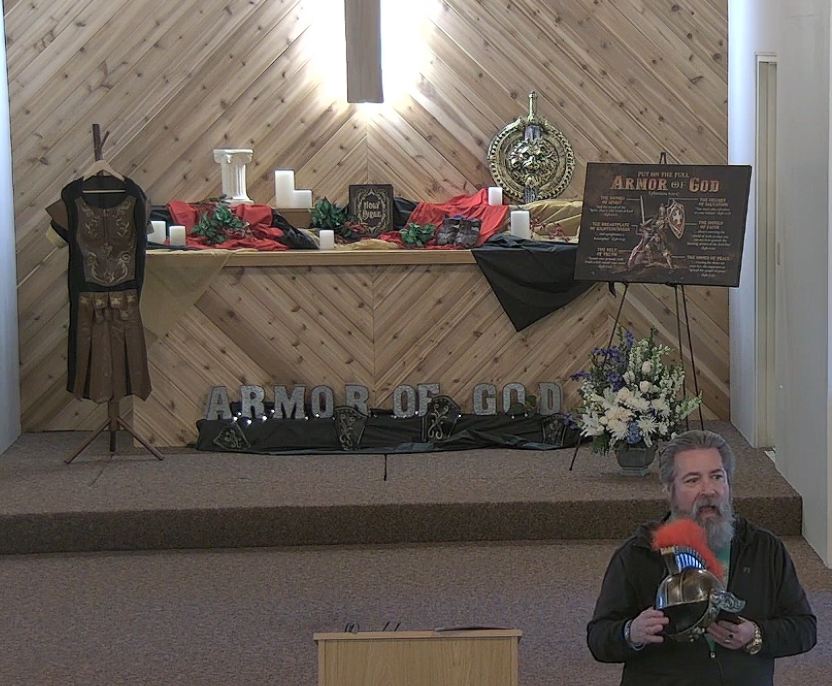
The armor Pastor Rod pointed to on the slide was the lorica segmentata — “segmented cuirass” — the distinctive Roman armor of the first century. It was made of overlapping horizontal iron strips riveted to internal leather straps, with curved shoulder guards and chest plates joined by buckles, hooks, and laces. Because it was built in segments it flexed with the torso; a soldier could bend, twist, breathe, and swing a sword. A rigid plate would have left him unable to fight. It weighed around twenty pounds and was, for its time, the most sophisticated body armor in the world.
Under it the soldier wore a padded garment (subarmalis) that absorbed impact and kept the iron from bruising. The armor was kept polished — partly for inspection and morale, partly because bright metal in Mediterranean sun was a genuine tactical asset. Pastor Rod’s observation is historically sound: an enemy facing a line of polished cuirasses at midday was fighting the glare as well as the soldier.
What It Protected
The breastplate covered the vital organs — heart, lungs, liver — the wounds that killed quickly. Arms and legs could be bandaged; a thrust to the chest ended the battle. Roman tactics reflected this: the legionary fought close, with a short stabbing sword aimed at the torso, and his own torso was the most protected part of him. Whoever kept his breastplate in place survived to fight the next day.
From Flak Jacket to Kevlar
Pastor Rod’s Marine Corps career spanned two generations of body armor. The flak vest of the Vietnam era was built to stop fragments — shrapnel, flak — but a rifle round could pass between its plates. In the 1970s a DuPont chemist, Stephanie Kwolek, developed an aramid fiber five times stronger than steel by weight; the Army and Marines fielded Kevlar vests and helmets in the following decade. The training film Pastor Rod described — a Kevlar vest taking rifle fire at close range, torn on the surface, unpierced beneath — was the standard way of convincing skeptical troops to trust the new gear. You might break a rib. You would not be pierced. And you would go into combat with a layer of protection you did not know you had.
4. Right vs. Righteous
The distinction Pastor Rod drew, laid out side by side:
|
|
Being right |
Being righteous |
|
What kind of thing it is |
A logical concept — correctness |
A relational concept — right standing before God |
|
Where it comes from |
Facts, reasoning, being on the correct side of a question |
A verdict God pronounces; credited by faith |
|
Who can have it |
Anyone — even a stopped clock, twice a day |
In ourselves, no one (Romans 3:10); in Christ, anyone who believes |
|
Can it be manufactured? |
Yes — study, argue, prove |
No — it is received as a gift (Romans 5:17) |
|
Its danger |
Pride; being right and unloving; being right and lost |
None — but it can be neglected, left off, or presumed upon |
|
Its relation to the belt of truth |
Built on truth, but can stop there |
Rests on truth and goes further — truth about who you are before God |
4a. Where in your life are you most tempted to settle for being right instead of being righteous — an argument, a relationship, a position you hold?
5. Given and Practiced
|
“God made him who had no sin to be sin for us, so that in him we might become the righteousness of God.” |
Righteousness You Are Given
Pastor Rod was emphatic: righteousness is not our works but the works of the Messiah. Read Romans 3:21-26 and Romans 4:1-8. Abraham believed God, and it was credited to him as righteousness. The word credited is a bookkeeping term — an amount placed in an account that did not earn it. Paul says the same happens for anyone who believes in the One who justifies the ungodly. The breastplate is issued, not earned. Compare Isaiah 61:10: “he has clothed me with garments of salvation and arrayed me in a robe of his righteousness.”
This is also why our own righteous acts cannot serve as armor. “All our righteous acts are like filthy rags” (Isaiah 64:6). Rags are not a breastplate. As Pastor Rod put it, it does not matter how often we attend church or how pious we look when we pray in the pews — that is not the metal that stops a blade.
Righteousness You Practice
But Pastor Rod was equally clear that righteousness is more than a one-time thing. Once saved, the Holy Spirit steers us in righteousness and away from sin — and we have to practice it every day. Read Titus 2:11-14: the same grace that saves teaches us to say no to ungodliness and live upright lives in this present age. Read 1 John 3:7-10: the one who practices righteousness is righteous, as He is righteous. And Romans 6:13: offer the parts of your body to God as instruments of righteousness.
The two are not in tension. The soldier did not forge his own armor — Rome issued it — but he had to buckle it on every morning, keep it polished, and refuse to take it off in the field. Given righteousness is the metal. Practiced righteousness is wearing it.
5a. Which do you tend to neglect — resting in the righteousness Christ gives you, or practicing righteousness daily? What does the neglect look like?
6. Guarding the Heart
|
“Above all else, guard your heart, for everything you do flows from it.” |
The breastplate protects the heart — in Scripture, the wellspring of life, the core of who a person is. Pastor Rod said Satan is a wellspring of death, and the breastplate is what keeps his blows from reaching the place where spiritual death begins. Three practices from the message keep it in place:
Submit and resist. “Submit yourselves, then, to God. Resist the devil, and he will flee from you” (James 4:7). Temptation is real — a new car, or something far more costly. The order matters: submission to God comes first, resistance second. Sheep who go their own way (Isaiah 53:6) are the ones who get bitten.
Cut off the trigger. “If your right hand causes you to stumble, cut it off” (Matthew 5:30). Pastor Rod applied this concretely: we each know what triggers our sins — a place, a group of people, an activity — the moment we are tempted to pull the armor off “just for a second.” Knowing the trigger and avoiding it is part of wearing the breastplate.
Let the old things go. When you first put on the armor, old friends may disappear. Some were righteous brothers; some were not. Pastor Rod’s counsel: the activities and company you were separated from were often not good for you, and God sends new friends (Psalm 1:1-3; 1 Corinthians 15:33; Proverbs 13:20).
Trigger Worksheet
Be honest and specific. This page is between you and God.
|
Where I take the armor off |
What Matthew 5:30 would mean here |
What I will put in its place |
|
A place: |
|
|
|
A group of people: |
|
|
|
An activity or habit: |
|
|
|
A time of day / state of mind: |
|
|
7. What Jesus Said About Righteousness
|
“But seek first his kingdom and his righteousness, and all these things will be given to you as well.” |
Since righteousness does not come from us, Pastor Rod turned to what Jesus says about it. Three commands stand out.
- Seek it first. Matthew 6:33 — not our righteousness but His, ahead of food, clothing, and tomorrow’s worries. The pursuit of His righteousness is the pursuit of Him.
- Hunger and thirst for it. Matthew 5:6 — a blessing on appetite, not achievement. The promise is not “blessed are the righteous” but “blessed are those who hunger for it — they will be filled.”
- Exceed the Pharisees. Matthew 5:20 — a righteousness greater than the most religious people alive. Impossible as performance; possible only as gift, then lived from the inside out.
Jesus also named the enemy of righteousness on display: doing it to be seen (Matthew 6:1). Polished armor reflects the sun, not the soldier. Pastor Rod’s closing prayer said it — we showcase His righteousness not because we are great but because He is.
7a. Matthew 5:6 blesses hunger. On a scale from indifferent to starving, how hungry are you for righteousness right now? What would increase the appetite?
8. Reflection Questions
1. “What is right is not always popular, and what is popular is not always right.” Where are you currently choosing popular over right? Where has choosing right cost you?
2. Paul puts the breastplate second, after truth. What does righteousness look like when it is not built on truth — and what does truth look like without righteousness?
3. The lorica segmentata was flexible; a rigid plate would have been useless. What would a rigid, inflexible righteousness look like in a person? How does the Spirit keep yours flexible?
4. Polished armor blinds the enemy. Pastor Rod said you may be reflecting Christ’s light without knowing it. Has anyone ever told you they saw something in you that you did not know was showing?
5. The Kevlar vest only worked because the Marines trusted the training film. Where do you need more confidence that His righteousness actually holds — not in theory, but under fire?
6. “No weapon forged against you will prevail” (Isaiah 54:17). What weapon is currently being forged against you? Write it down, and write the verse next to it.
9. This Week: Daily Armor Check
The armor only protects you if you wear it. Each morning this week, record one place you will need the breastplate, and each evening whether it stayed on.
|
Day |
Where I’ll need it today |
Did it stay on? What happened? |
Verse |
|
Mon |
|
|
|
|
Tue |
|
|
|
|
Wed |
|
|
|
|
Thu |
|
|
|
|
Fri |
|
|
|
|
Sat |
|
|
|
|
Sun |
|
|
|
10. For Further Study
Read these passages during the week. Each one develops a thread from the message.
- Isaiah 59:1-21 — When there was no one to intervene, God armed Himself. The source of Paul’s imagery.
- Isaiah 61:10-11 — Clothed with garments of salvation, arrayed in a robe of righteousness.
- Jeremiah 23:5-6 — The righteous Branch: “The LORD Our Righteousness.”
- Malachi 4:1-3 — The sun of righteousness rising with healing in its rays.
- Romans 3:9-26 — None righteous; righteousness from God through faith.
- Romans 5:12-21 — The gift of righteousness through one Man.
- Philippians 3:7-11 — Not a righteousness of my own.
- Titus 2:11-14 — Grace that teaches us to live upright lives now.
- 1 John 2:28-3:10 — Practicing righteousness as children of God.
- Exodus 28:15-30 — The high priest’s breastpiece, worn over the heart.
Next week: The Shoes of the Gospel of Peace — Ephesians 6:15