

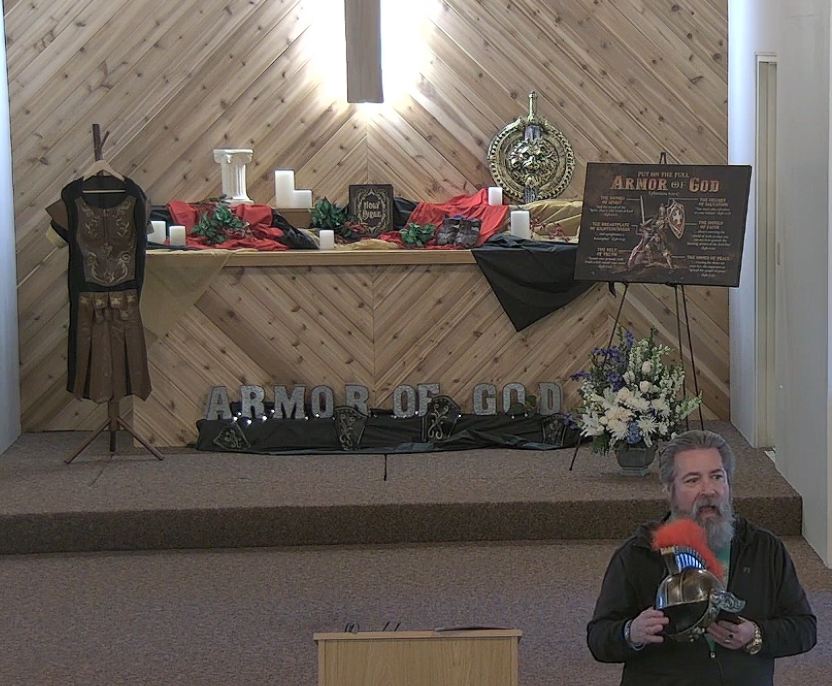


THE ARMOR OF GOD
Week Two
Buckle Up for Truth
The Belt of Truth • Ephesians 6:14a
Beyond the Sermon Workbook
Pastor Rod Meyers • Covington Community Church
All scripture quotations from the New International Version (NIV). Verse references are linked to BibleGateway.
|
“Stand firm then, with the belt of truth buckled around your waist, with the breastplate of righteousness in place,” |
A belt is not the piece of equipment anyone brags about. It is not the sword, the shield, or the helmet. But for a Roman soldier, it was the piece everything else hung on. Paul lists it first for a reason: without truth, there is nothing to hang the rest of the armor on. This workbook takes the message deeper — into the Greek and Hebrew words, the world of the Roman soldier, the logic of lies, and the practical question of how a believer actually wears the truth in an age of deception.
How to use this workbook: Read each section with your Bible open. Click any reference to read it in full. Write your answers in the space provided — the goal is not to finish quickly but to think clearly.
1. The Sermon in Brief
Pastor Rod opened with a story from his years as a high school history teacher, when a principal asked him to teach a course on logic. He sold it to a room of freshmen with one question: “How would you like to win an argument with your parents?” Every hand went up. But the real purpose of logic is not winning arguments. Logic exists to expose fallacies — to separate truth from falsehood. Build on a true premise and you reach a true conclusion; build on a lie and the whole structure collapses.
That is why Paul lists truth first. The Roman soldier’s belt held his sword, secured his tunic, protected his midsection, and kept him ready to move. It was not decorative. In the same way, truth is the load-bearing piece of the Christian’s armor. Key points from the message:
- We live in an age of deception — altered images, AI-generated narratives, political half-truths — and Jesus warned that deception would mark the end of the age.
- The deceiver has been at work since Genesis 3. A half-truth is still a lie.
- Satan’s favorite target is the character of God: Can you trust Him? Does He hear you? Is He really good? The belt of truth reminds us who God is.
- Truth must be spoken in love (Ephesians 4:15). Soldiers check each other’s equipment before a jump; believers check each other’s beliefs against the Word — kindly.
- The truth sets you free (John 8:32) — free to help your neighbor, free to change the world, free to live the life you were called to.
- Pilate asked, “What is truth?” while looking directly at Him (John 18:37-38). Rome was his truth. We serve another.
2. Word Studies
Paul’s phrase in Ephesians 6:14 is more literal in the Greek than most English translations show: “having girded your loins with truth.” Three words carry the weight.
|
Greek: ἀλήθεια (alētheia) — “truth” |
|
Literally “un-hiddenness” — from a- (not) and lanthanō (to escape notice, to be hidden). In Greek thought, truth is reality with the covering pulled off. It is not merely a correct statement; it is what is actually there once the concealment is removed. In John’s writings the word is tied directly to Jesus. He is “full of grace and truth” (John 1:14), He is “the truth” (John 14:6), and He came to “testify to the truth” (John 18:37). The belt of truth, then, is not only true doctrine — it is a Person and His Word (John 17:17). Used 109 times in the New Testament. Also appears in this same letter: Ephesians 1:13, Ephesians 4:15, Ephesians 4:21, Ephesians 4:24-25, Ephesians 5:9. |
|
Greek: περιζώννυμι (perizōnnymi) — “to gird about, to buckle on” |
|
Peri (around) + zōnnymi (to gird). It describes wrapping and fastening a belt around the waist so that loose clothing is gathered up and secured. Paul uses the aorist participle — an action completed and then relied on: gird yourself, and stay girded. The same word appears when Jesus tells His servants to keep themselves “dressed ready for service” (Luke 12:35) and when the risen Christ is seen with a golden sash (Revelation 1:13). It is the language of readiness. Paired with ὀσφύς (osphys), “loins” or “waist” — the core of the body, the center of strength and movement. See Peter’s parallel: “with minds that are alert and fully sober” — literally, “gird up the loins of your mind” (1 Peter 1:13). |
|
Hebrew: אֱמֶת (emet) — “truth, faithfulness, firmness” |
|
The Old Testament word behind Paul’s thinking. Emet comes from the root aman — to be firm, reliable, established. It is the same root as amen (“so be it, it stands”) and emunah (“faithfulness”). In Hebrew, truth is not an abstraction; it is what holds. It is the ground you can put your weight on. Notice how this fits Paul’s command to “stand firm.” Truth is what you stand on because truth is what stands. “Guide me in your truth” (Psalm 25:5). “The LORD delights in people who are trustworthy” (Proverbs 12:22) — the word there is emunah, from the same root. Most striking of all: the Messiah Himself wears this belt. “Righteousness will be his belt and faithfulness the sash around his waist” (Isaiah 11:5). The armor Paul describes is God’s own armor (compare Isaiah 59:17). When you buckle on the belt of truth, you are wearing what the King wears. |
3. Historical Background: The Soldier’s Belt
Paul’s View from Prison
Paul wrote Ephesians as “an ambassador in chains” (Ephesians 6:20). During his Roman imprisonment he was allowed to live under guard rather than in a cell (Acts 28:16, Acts 28:30-31), and he tells the Philippians that “the whole palace guard” knew why he was there (Philippians 1:13). The soldiers rotated in shifts, chained to him. Paul did not have to imagine the armor of God. He had a Roman soldier, fully equipped, at arm’s length for months.
The Cingulum Militare
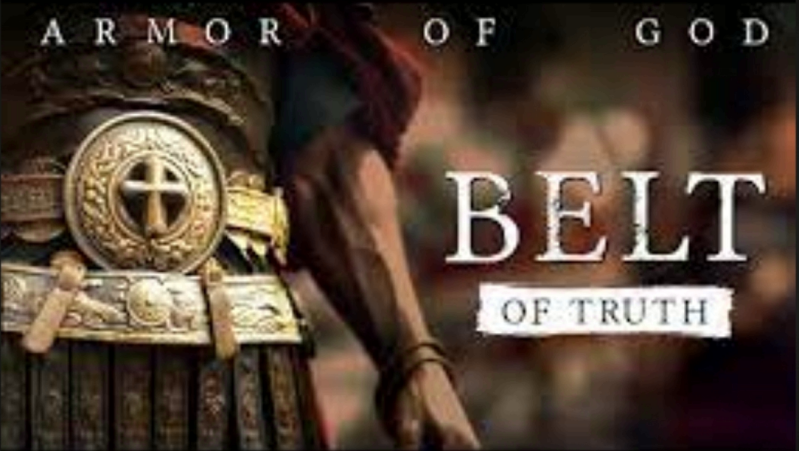
The Roman military belt — the cingulum or balteus — was a wide leather belt reinforced with metal plates. From it hung an apron of studded leather straps that protected the lower abdomen and thighs. The soldier’s sword (gladius) and dagger (pugio) hung from it, positioned so the hand fell to the hilt without looking. Before a march or a battle, the soldier tucked the loose folds of his tunic up into the belt so his legs were free — the origin of the phrase “gird up your loins.”
The belt was also the mark of a soldier. A civilian did not wear one. To be stripped of the belt was a public disgrace, and a soldier who was discharged in shame had it taken from him. To “put on the belt” was, in Roman eyes, to become a soldier at all.
Gird Your Loins: The Exodus Pattern
|
“This is how you are to eat it: with your cloak tucked into your belt, your sandals on your feet and your staff in your hand. Eat it in haste; it is the LORD’s Passover.” |
Israel ate the first Passover already belted for departure. They did not yet know they would face Pharaoh’s army at the sea; they only knew God had said “be ready.” Readiness came before the battle, not after. See also 1 Kings 18:46 (Elijah tucks his cloak into his belt and outruns a chariot) and 2 Kings 4:29.
4. Three Kinds of Belt
Pastor Rod drew a sharp line between the belt we wear to hold up our trousers and the belt a soldier wears into combat. Here is the comparison, extended to the belt Paul has in mind:
|
|
Decorative belt |
Roman battle belt |
Belt of truth |
|
Purpose |
Holds up clothing; looks good |
Secures the body, carries weapons, enables movement |
Anchors every other piece of spiritual armor |
|
What hangs on it |
Nothing essential |
Sword, dagger, protective apron |
Righteousness, readiness, faith, salvation, the Word |
|
What it protects |
Nothing |
The midsection — vital organs, blows below the belt |
The core of who you are: your understanding of God and yourself |
|
If it fails |
Mild embarrassment |
Sword out of reach, tunic tangled, soldier exposed |
Nothing to build on; every other piece slips |
|
Who wears it |
Anyone |
Soldiers only — it marks military status |
Those who belong to the One who is Truth |
|
Who provides it |
You buy it |
Rome issues it |
God provides it — it is His armor (Isaiah 59:17) |
5. The Logic of Lies
Logic, Pastor Rod reminded us, comes down from the Greek world of Socrates and Aristotle, and it works like algebra: A is true, B is true, therefore C. Every conclusion depends on its premises. A false premise produces a false conclusion no matter how careful the reasoning that follows.
|
Premise A |
Premise B |
Conclusion |
|
Jesus is God (John 1:1) |
God created all things (Genesis 1:1) |
Therefore Jesus is the Creator (Colossians 1:16) — true |
|
The devil created the universe |
Look at the state of the world |
Therefore the devil made the world we live in — false, because Premise A is false |
|
God is withholding something good from you |
God said not to eat from the tree |
Therefore God cannot be trusted — the serpent’s conclusion in Genesis 3 |
The First Half-Truth
Read Genesis 3:1-6. The serpent never told an outright lie at first. He asked a question that bent God’s words (“Did God really say…?”), then denied the consequence (“You will not certainly die”), then offered a premise that was technically true — their eyes would be opened — wrapped around a false conclusion about God’s motives.
A half-truth works precisely because part of it is true. As a young officer, Pastor Rod was taught the test: the whole truth, and nothing but the truth. Anything less — including staying silent when you know the truth — is not the truth.
Jesus called the devil “a liar and the father of lies” (John 8:44). Paul warned that the same serpent who deceived Eve still works by cunning to lead minds astray from “sincere and pure devotion to Christ” (2 Corinthians 11:3).
5a. Identify the true part and the false part of the serpent’s statement in Genesis 3:4-5. Which part made the lie believable?
6. An Age of Deception
|
“Jesus answered: “Watch out that no one deceives you.”” |
When the disciples asked Jesus about the sign of His coming and the end of the age, His very first words were a warning about deception (Matthew 24:4-5). He repeated it twice more in the same discourse: false prophets deceiving many (Matthew 24:11), and false messiahs performing signs great enough “to deceive, if possible, even the elect” (Matthew 24:24).
Paul saw the same trajectory. In the last days people will follow deceiving spirits (1 Timothy 4:1), imposters will go “from bad to worse, deceiving and being deceived” (2 Timothy 3:13), and the coming lawless one will operate through “every sort of evil that deceives those who are perishing” — because “they refused to love the truth” (2 Thessalonians 2:9-12).
That last phrase deserves attention. The ones deceived in that passage are not victims of a lie too clever to detect. They are people who did not love the truth enough to want it. Deception at the end of the age is not primarily an intelligence problem; it is an affection problem.
Pastor Rod pointed out that we are living in the first generation where a photograph, a voice, or a video can be generated and cannot be trusted on sight. AI is a tool — he used it himself preparing a video for Nigeria — but the age it belongs to is one Jesus described in advance. Loving the truth has never been more urgent.
6a. Where are you most likely to be deceived — by what you see online, by what you feel, or by what you hear about God? Why that one?
7. Truth in Love: The Equipment Check
|
“Instead, speaking the truth in love, we will grow to become in every respect the mature body of him who is the head, that is, Christ.” |
Paratroopers check each other’s equipment before a jump. Every strap, every buckle. Nobody takes offense, because everyone knows what is at stake. Pastor Rod applied this directly: believers can check each other’s belts. We can test one another’s narratives against the Word and help each other before the battle — not to provoke, but to protect.
Paul does not allow truth without love or love without truth. Two verses later he says “each of you must put off falsehood and speak truthfully to your neighbor, for we are all members of one body” (Ephesians 4:25). The reason for honesty is belonging. Compare Galatians 6:1 (restore gently), Proverbs 27:6 (wounds from a friend can be trusted), and Proverbs 27:17 (iron sharpens iron).
Truth spoken without love is a weapon turned on your own side. Love without truth leaves a brother walking into battle with a loose belt. God models both at once — He is “full of grace and truth” (John 1:14).
7a. Who in your life is allowed to check your equipment — to tell you when what you believe does not line up with the Word? If no one, why not?
7b. Is there someone you have been avoiding a hard, true conversation with? What would speaking the truth in love look like this week?
8. The Truth Will Set You Free
|
“Then you will know the truth, and the truth will set you free.” |
Notice the condition Jesus attaches to this promise. Read the verse before it (John 8:31-32): “If you hold to my teaching, you are really my disciples. Then you will know the truth…” Freedom comes through abiding in His Word, not through a single moment of insight. And the freedom is specific — freedom from sin’s slavery (John 8:34-36).
Pastor Rod said the last thing the enemy wants you to be is free — free to help your neighbor, free to make changes in this world, free to represent the Kingdom, free to live the life you were called to live. A believer bound by lies about God is a soldier who cannot move.
Truth Is a Person
Pilate stood in front of Jesus and asked, “What is truth?” (John 18:37-38). Pilate had his own truth — that Rome was powerful and he served it — and it walked him straight into the worst decision in history. Meanwhile the answer to his question was standing in front of him: “I am the way and the truth and the life” (John 14:6).
This is why the belt of truth cannot be manufactured. It is not our truth, our salvation, our grace. It is His. God “does not lie” (Titus 1:2); it is “impossible for God to lie” (Hebrews 6:18); His Word is truth (John 17:17; Psalm 119:160). Every other piece of armor is fastened to that.
8a. What lie about God have you been most tempted to believe — that He does not hear you, that He is not good, that He cannot be trusted with your future? What does Scripture say in its place?
9. Reflection Questions
1. Why do you think Paul lists truth first, before righteousness, faith, or the Word? What does the order tell you?
2. Pastor Rod said a half-truth is still a lie, and staying silent when you know the truth is also a failure of truth. Where is silence costing you integrity right now?
3. The Roman belt was the mark of a soldier. What would it look like for the people around you to recognize, by how you handle truth, that you belong to Christ?
4. Israel ate the Passover already girded for a journey they did not understand. What is God asking you to be ready for before you can see it?
5. Pastor Rod noted that each Roman belt was individually decorated — the truth is universal, but how you carry it is personal. How has God uniquely equipped you to bear witness to the truth?
6. Satan attacks the idea of God more than anything else. Write out one truth about God’s character, with a verse, that you will keep close this week.
10. Daily Equipment Check
Pastor Rod said we must put on truth every single day. Use this checklist each morning this week. The bracelet on your wrist is a reminder; this is the practice.
|
Day |
Truth about God I am standing on today |
Lie I am refusing today |
Verse |
|
Mon |
|
|
|
|
Tue |
|
|
|
|
Wed |
|
|
|
|
Thu |
|
|
|
|
Fri |
|
|
|
|
Sat |
|
|
|
|
Sun |
|
|
|
11. For Further Study
Read these passages during the week. Each one develops a thread from the message.
- Isaiah 11:1-5 — The Messiah’s belt of righteousness and faithfulness. The armor is His before it is ours.
- Isaiah 59:15-21 — God puts on His own armor when there is no truth in the land. Paul’s source for Ephesians 6.
- Psalm 15 — Who may dwell on God’s holy mountain? The one “who speaks the truth from their heart.”
- Psalm 51:6 — God desires truth in the inward parts. The belt goes around the core.
- Zechariah 8:16-17 — Speak the truth; render true judgment; the LORD hates false oaths.
- John 8:31-47 — Truth, freedom, and the father of lies, in full context.
- 2 Corinthians 10:3-5 — Demolishing arguments and taking every thought captive to Christ. The belt of truth in action.
- 1 John 4:1-6 — Testing the spirits: “the Spirit of truth and the spirit of falsehood.”
- 2 Timothy 2:15 — Correctly handling the word of truth.
- 1 Peter 5:8-9 — The prowling lion, and standing firm in the faith.
Next week: The Breastplate of Righteousness — Ephesians 6:14b